
Sermorelin
The Original Growth Hormone Releasing Peptide
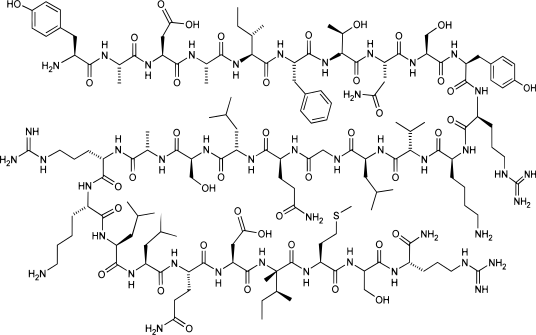
Sermorelin is the front half of a real human hormone. It is the first 29 amino acids of GHRH, the signal your hypothalamus sends when it wants the pituitary to release growth hormone, and that fragment carries the hormone's full activity. Inject it, and the body answers with a pulse of its own growth hormone, feedback brakes intact.
It also has a history no other peptide in this directory shares: it was once a fully approved medicine called Geref, then quietly left the market in 2008 for business reasons, not safety ones, and lives on today as a widely compounded classic.

What we've seen in practice
Sermorelin is where this whole family started for us. When Dr. Koniver describes how the practice moved away from growth hormone itself, he puts it simply: the growth-hormone-releasing peptides began with sermorelin, which we still use, and evolved from there to peptides like ipamorelin. So sermorelin holds a particular place in our toolkit: the original, the first generation, the one that proved the idea that you could restore a natural pulse instead of replacing the hormone.
His assessment of it is refreshingly unvarnished. He calls sermorelin well rounded, still widely used, still readily available, and genuinely liked by the people who use it, delivering a moderate release of growth hormone. He also rates it, in his own words, as average, middle of the road. Tesamorelin, its next-generation successor, is stronger and seems to preserve lean muscle better. Ipamorelin became our everyday workhorse for other reasons. Sermorelin sits between them: dependable, flexible, unspectacular, and still earning its keep after decades.
Two practical notes from our use. First, like tesamorelin and unlike ipamorelin and the other releasing peptides, sermorelin does not need to be paired with CJC-1295, because the GHRH signal is what sermorelin already is. Second, it belongs at bedtime. Dr. Koniver groups it with ipamorelin and tesamorelin as the peptides we time with the body's natural nighttime growth hormone pulse, so the signal lands when the pituitary is already listening, supporting the slow work of recovery and repair.
Sermorelin at a glance

The first 29 amino acids of natural human GHRH, the shortest fragment that keeps the hormone's full activity; formerly the approved medicine Geref [1, 4]
.svg)
Prompting the body's own growth hormone release: recovery, body composition, and sleep-adjacent restoration; historically, diagnosing and treating growth hormone deficiency in children
.svg)
Genuine human clinical data from its approved era (1990s pediatric trials and diagnostic use); adult wellness use rests on physiology, smaller studies, and clinical experience [1, 2]
.svg)
By injection, classically at bedtime to work with the natural growth hormone pulse
.svg)
29 amino acids, formula C149H246N44O42S, about 3,357.9 g/mol, plasma half-life measured in minutes [4]

Formerly FDA-approved (Geref, 1990 and 1997), discontinued 2008 for commercial reasons, approvals withdrawn 2009; today available through compounding; prohibited in sport by WADA. Details below

The first-generation classic we still use: well rounded, moderate, honestly rated middle of the road. See what we have seen in practice above
Solid beads = sermorelin, GHRH(1-29). Ghosted beads = the rest of the natural 44-amino-acid hormone, which adds nothing essential to the signal. One injection, one clean pulse: the half-life is minutes, by design of the biology.
Where sermorelin comes from
Growth hormone releasing hormone was isolated in the early 1980s, and researchers quickly established that its front section did all the work. That fragment, GHRH(1-29), was developed into a pharmaceutical: sermorelin, brand name Geref. The FDA approved a diagnostic version in 1990, used to test whether a child's pituitary could release growth hormone at all, and a treatment version in 1997 for children with growth hormone deficiency.
Then came the quiet exit. In 2008 the manufacturer discontinued Geref, a commercial decision in an era when biotech growth hormone dominated the market, and the approvals were formally withdrawn in 2009. Notably, the FDA later put on record that Geref was not withdrawn for safety or effectiveness reasons. That finding matters: it is part of why sermorelin lives on legitimately today as a compounded preparation, and why a peptide with a 1990s pedigree is still part of modern wellness practice.
Natural GHRH (44 aa)
GHRH(1-29), full activity
Geref, then compounded sermorelin
How it works
Sermorelin's mechanism is the natural one, borrowed rather than invented.


Sermorelin binds the GHRH receptor on the pituitary's growth-hormone-producing cells, the same receptor the natural hormone uses, and prompts them to synthesize and release growth hormone as a pulse.[1]

.svg)
Because the release is pituitary-made rather than injected, somatostatin, the body's stop signal, still regulates it, and the normal feedback loops still apply. Prompting your own growth hormone is not the same as taking growth hormone.[1, 2]
.svg)
The released pulse drives IGF-1 production and the familiar growth hormone effects: protein synthesis, tissue repair, fat metabolism, and the deep-sleep-associated recovery cycle that bedtime dosing is designed to ride.[1]
Genuine human evidence, decades old, honestly bounded.
What the research shows
Sermorelin is unusual in this directory: it has real human clinical evidence, and most of it is decades old.
From its approved era, the pediatric record is genuine and specific. As a diagnostic, an intravenous dose was a rapid, relatively specific test of the pituitary's ability to release growth hormone. As a treatment, daily bedtime injections increased growth velocity in some children with growth hormone deficiency, with gains sustained over a year of treatment and, in a smaller group, out to three years. The same literature is honest about the ceiling: head-to-head comparisons at similar weight-based dosing showed smaller growth effects than direct growth hormone. Effective, gentler, and weaker than the hormone itself - a fair one-line history, and consistent with how Dr. Koniver rates it today.
Adult use stands on a different footing. The case for sermorelin in adult wellness rests on GHRH physiology, the approved-era safety record, smaller studies of GHRH fragments in aging, and published arguments that restoring the natural pulse is a sounder approach than replacing the hormone - plus clinical experience like ours. What it does not rest on is large adult randomized trials of sermorelin, because they have not been done. We think that distinction should be stated, not blurred.
One more thing worth flagging. A paper that circulates as evidence that sermorelin treats recurrent brain tumors is a computational drug-screening analysis. No patients received sermorelin in it.
Pediatric growth hormone deficiency
Approved-era clinical trials and reviews
Increased growth velocity in some children; effects smaller than direct growth hormone
Genuine human evidence, decades old [1]
Pituitary testing
Approved-era diagnostic use
A rapid, relatively specific test of growth hormone release
Established historical use [1]
Adult restoration and wellness
Physiology, small studies, published perspectives, clinical experience
A rationale for pulse-based restoration with feedback intact
Not settled by large trials [2]
Large adult randomized trials
None
Not independently established at scale
A genuine gap
How strong is the evidence
Genuine approved-era human evidence with an honest adult-evidence gap.
The approved-era record is the backbone here, and it is reassuring: sermorelin was well tolerated in children in trials, with the most common effects being transient facial flushing and pain or redness at the injection site, plus an occasional passing headache. Our experience with it in adults matches that gentle profile, which fits a mechanism that prompts a natural pulse rather than forcing a level.
The cautions are the growth-hormone-axis standards. Physician screening rules out active cancer and growth-hormone-sensitive tumors, since growth signals and malignancy do not mix. Blood sugar deserves monitoring in people with diabetes or glucose intolerance. We avoid it in pregnancy and breastfeeding. And because today's sermorelin is a compounded product rather than a factory-boxed brand, the quality of the pharmacy matters, as does supervision with lab follow-up, which is how we use everything in this family.
Regulatory status
Regulatory information current as of 13 August 2026.
This is a summary, not legal or medical advice, and status can change.

Geref diagnostic approved
pituitary testing
Geref treatment approved
pediatric growth hormone deficiency
Discontinued
a commercial decision by the manufacturer
Approvals withdrawn
formal housekeeping after discontinuation
FDA determination
not withdrawn for safety or effectiveness
Compounded classic
FDA 503A Category 1 bulks list; no approved product on market
United States
FORMERLY APPROVED - NOW COMPOUNDED
Approved as Geref (1990 diagnostic, 1997 pediatric treatment); discontinued 2008; approvals withdrawn 2009, with FDA recording the withdrawal was not for safety or effectiveness. Today available through compounding under physician prescription; on the Category 1 bulks list; untouched by the 2023 Category 2 action.
Sport (WADA)
Prohibited - S2, at all times
The WADA Prohibited List bans GHRH and its analogues and names sermorelin explicitly, alongside CJC-1295 and tesamorelin. Competing athletes should treat sermorelin as prohibited.
Everywhere else
No current marketing approvals as a medicine; availability runs through compounding frameworks where those exist, and rules differ by country. Quality risks outside licensed channels per the safety section.
Common questions
Not currently. It was an approved medicine, Geref, from the 1990s until 2008, when it was discontinued for commercial reasons; the approvals were withdrawn in 2009, and the FDA has stated the withdrawal was not about safety or effectiveness. Today it is available through compounding. The regulatory section above has the full timeline.
They pull different levers. Sermorelin is the GHRH signal itself, telling the pituitary to release growth hormone; ipamorelin works through the separate ghrelin receptor to do the same job. In our practice ipamorelin became the everyday workhorse, while sermorelin remains the flexible first-generation option some patients do well on.
Both are GHRH analogs, so neither needs CJC-1295 added. Tesamorelin is the stronger, next-generation version, with a particular reputation for visceral fat; Dr. Koniver considers it the more powerful of the two and better at preserving lean mass. Sermorelin is the milder original.
Because growth hormone is released mainly in the first hours of deep sleep. Timing sermorelin at bedtime aims its pulse at the window when the pituitary is naturally most ready, which is how we use the whole releasing-peptide family.
No. WADA prohibits GHRH analogues at all times and names sermorelin specifically; see the regulatory section above.
Related peptides


References
- Prakash A, Goa KL. Sermorelin: a review of its use in the diagnosis and treatment of children with idiopathic growth hormone deficiency. BioDrugs. 1999;12(2):139-157. PMID 18031173.
- Walker RF. Sermorelin: a better approach to management of adult-onset growth hormone insufficiency? Clin Interv Aging. 2006;1(4):307-308. PMID 18046908. (An editorial perspective, cited as such.)
- US Food and Drug Administration. Determination That GEREF (Sermorelin Acetate) Injection Was Not Withdrawn From Sale for Reasons of Safety or Effectiveness. Federal Register, 4 March 2013 (2013-04827). (Approval, discontinuation, and withdrawal record for NDA 19-863 and NDA 20-443.)
- Molecular data: sermorelin, GHRH(1-29)-NH2, PubChem CID 16132413, formula C149H246N44O42S, molecular weight ~3,357.9 g/mol. Sport status: WADA Prohibited List, class S2 (GHRH and its analogues, sermorelin named).
- Koniver C. The Koniver Method - clinical training for physicians, nurse practitioners and physician assistants (peptide modules). Statements attributed to Dr. Koniver and to the Koniver Wellness practice reflect clinical observation and teaching.
This page is for informational and educational purposes and does not constitute medical advice, diagnosis, or treatment. Sermorelin is not currently an FDA-approved marketed medicine; it was formerly approved as Geref and is available today through compounding pharmacies under physician prescription. Statements describing how Dr. Koniver and the Koniver Wellness team use sermorelin reflect clinical experience and judgment, which is not the same as controlled clinical evidence. Nothing here is a substitute for consultation with a qualified healthcare provider. Peptide therapy at Koniver Wellness is provided under physician supervision after appropriate screening, and the availability of any given peptide depends on its regulatory and supply status.
INTERESTED IN PEPTIDES?
START WITH THE RIGHT QUESTIONS.
Understand what peptides can and cannot do, what the evidence actually says, and whether physician-guided peptide therapy makes sense for you.