
CJC-1295
What We've Seen in Practice, and What the Research Says
CJC-1295 is a growth-hormone peptide with a split personality, and understanding the split is the whole point. It is a lab-made copy of growth hormone-releasing hormone, the natural signal your brain uses to tell your pituitary to release growth hormone. On its own that signal lasts only minutes. CJC-1295 was engineered to last far longer, and depending on exactly how it is made, it lasts either a few hours or a full week. Those two versions are almost different drugs, and most of the confusion around this peptide comes from treating them as one.
This page keeps them separate, tells you which one the published research actually studied, and explains which one we use in practice and why.

What we've seen in practice
At Koniver Wellness, CJC-1295 is almost never the star of a protocol. It is the partner. Several of the growth-hormone peptides we use, ipamorelin most often, but also others in that family, work best when they are given alongside a growth-hormone-releasing-hormone signal. CJC-1295 supplies that signal. On its own it does little that a patient would notice; paired with the right partner it lets that partner do its full job. In Dr. Koniver's framing, it is the agent that helps the other peptide work completely, not a stand-alone therapy.
There is one rule Dr. Koniver is firm about, and it shapes how we use this peptide entirely: we use the short-acting form, the one made without the albumin anchor known as DAC. The reasoning is about rhythm. Your body releases growth hormone in pulses, with quiet troughs in between, and that pattern matters. The short-acting form gives the pituitary a nudge and then lets it settle, which keeps the natural pulse intact. The long-acting form, the true CJC-1295 with DAC, keeps the signal switched on for days, which flattens the rhythm into something more like a constant hum. We prefer to work with the body's pulse, not paper over it, so we use the version that pulses.
That preference also lines up with how these peptides sit in our practice more broadly: we use them episodically, in courses, to support a season of recovery or training rather than as a permanent add-on. Some peptides in the growth-hormone family carry their own releasing-hormone action and do not need CJC-1295 at all; tesamorelin and sermorelin are the ones we reach for when we want a stand-alone. CJC-1295 earns its place specifically as the amplifier in a pairing.
As with every peptide here, screening comes first. Because this family raises growth hormone and IGF-1, we rule out active cancer and pregnancy before we begin, and we are cautious with anyone who has a history of hormone-sensitive disease. These are tools for well-screened people, used carefully.
The research behind these observations, including Dr. Koniver's clinical observations, follows below.
CJC-1295 at a glance

A synthetic analog of growth hormone-releasing hormone (GHRH), engineered to resist the enzymes that break the natural hormone down within minutes [1,4]

With DAC (an albumin anchor): lasts about a week, the form the human trials studied. Without DAC (also called Mod GRF 1-29): brief, hours not days, the form we use in practice[1,2]
.svg)
Raising the body's own growth hormone and IGF-1; studied historically for HIV-related fat changes; discussed today for recovery, body composition, and healthy aging [1, 5]
.svg)
Small controlled human trials of the with-DAC form show a real, sustained rise in GH and IGF-1; corporate development halted in 2006; the without-DAC form has little published trial data of its own [1,2,5]
.svg)
Subcutaneous injection; used in practice paired with a growth-hormone-releasing peptide
.svg)
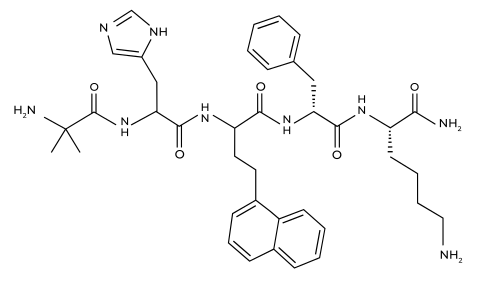
Formula C165H269N47O46 · weight 3,647.2 g/mol · a 29-amino-acid GHRH backbone plus stabilizing modifications[4]

Used under physician supervision, in courses, as the releasing-hormone partner in a pairing, in the short-acting form only. See what we've seen in practice above, and the regulatory status below
Stabilized GHRH backbone. Brief action, hours not days. Nudges a natural pulse, then steps back.
+ albumin anchor (DAC)
Same backbone plus an anchor to a blood protein. Lasts about a week. Keeps the signal switched on.
Where CJC-1295 comes from
Your body runs growth hormone on a timer. The hypothalamus sends out growth hormone-releasing hormone, the pituitary answers with a pulse of growth hormone, and then the signal fades, because natural GHRH is destroyed within a few minutes. That short life is useful biologically, but it makes GHRH almost useless as a medicine: you would have to infuse it continuously.
A Canadian company, ConjuChem, set out to fix that in the early 2000s. They took the active fragment of GHRH, made four small amino acid changes so enzymes could not chop it up as quickly, and then added the clever part: a chemical handle that latches permanently onto albumin, the most abundant protein in blood. Anchored to albumin, the peptide rides along in circulation for days instead of minutes. That anchored version is the true CJC-1295, and its formal name for the anchor is the Drug Affinity Complex, or DAC.
ConjuChem tested it in people, mainly for the fat changes that come with HIV treatment. The program ended in 2006 after the company halted a mid-stage trial when a participant died; the death was investigated and never publicly tied to the drug, but development stopped and never restarted. A parallel Canadian peptide aimed at the same condition kept going, and it became tesamorelin, which later earned FDA approval. CJC-1295 itself never did, and it lives on today mostly through compounding pharmacies and the wellness world, where the shorter-acting version without the albumin anchor became popular.
How CJC-1295 works

.svg)
CJC-1295 binds the same pituitary receptor that natural GHRH uses and asks the pituitary to release its own growth hormone, which then prompts the liver to make IGF-1. It is not growth hormone itself; it is the upstream signal that calls for it.[1, 2]

.svg)
Four amino acid substitutions slow the enzymes that normally degrade GHRH. In the with-DAC form, the albumin anchor extends that further, to a measured half-life of roughly six to eight days.[1]
.svg)
Sampling growth hormone overnight after a long-acting dose, the natural pulses were unchanged in size and frequency, but the quiet troughs between them rose sharply, about sevenfold, lifting overall growth hormone by roughly half. The pulses continue, but the off periods are no longer really off.[2]
The published pharmacology, all in the with-DAC form [1, 2, 5]
What the research shows
The honest headline is that the good human research is about one version of this peptide, and the popular version is the other one.
The with-DAC form was studied properly. In the anchor trial, healthy adults given a single injection saw their average growth hormone rise several-fold and stay elevated for six days or more, with IGF-1 up for nine to eleven days; repeated dosing held IGF-1 above baseline for up to four weeks, and no serious adverse reactions were reported. A second study confirmed the hormonal picture and added the pulsatility detail above. Animal work in growth-hormone-deficient mice showed the peptide could normalize growth. So the biochemistry is not in doubt: CJC-1295 with DAC reliably raises growth hormone and IGF-1 in people.[1, 2, 3]
What is missing is the next step. There are no large, long-term human trials showing that this hormonal rise translates into the outcomes people want from it, the body-composition and recovery and healthy-aging claims, and there is very little published human data at all on the without-DAC form that most people, us included, actually use.
Its case rests on sharing the same mechanism, not on its own trials. Anyone presenting CJC-1295 as an established anti-aging therapy is reaching well past the evidence; anyone dismissing it entirely is ignoring a clean, repeated demonstration that it does what it says to the hormones it targets. Both are true at once.
Teichman 2006
Healthy adults, ages 21-61
Two randomized, double-blind, placebo-controlled ascending-dose trials (28 and 49 days); with-DAC form
Single dose raised mean GH 2- to 10-fold for 6+ days and IGF-1 1.5- to 3-fold for 9-11 days; half-life 5.8-8.1 days; no serious adverse reactions
Small; short; biochemical endpoints, not clinical outcomes [1]
Ionescu and Frohman 2006
Healthy men, 20-40
Overnight 20-minute GH sampling before and after one dose; with-DAC form
Pulse frequency and size unchanged; trough GH up ~7.5-fold; overall GH +46%, IGF-1 +45%
Single dose; small; hormonal endpoints[2]
Alba 2006
GHRH-deficient mice
Daily CJC-1295
Normalized growth and GH/IGF-1 axis
Animal model [3]
The evidence, area by area
In the published human studies, the with-DAC form was generally well tolerated, with no serious adverse reactions reported and side effects limited to things like injection-site reactions and mild fluid retention. That is a genuinely reassuring short-term picture for the hormonal effect it produces.[1]
The honest limits are real. The studies were small and short, so long-term safety in wide use is not established, and the corporate program that would have generated that data stopped in 2006. Because CJC-1295 raises growth hormone and IGF-1, it carries the same theoretical caution that applies to anything in this family: elevated growth signaling is a reason for care in anyone with active cancer or a history of hormone-sensitive disease, and it is why our screening rules those out before we begin, along with pregnancy. Excessive or careless dosing that pushes IGF-1 too high is its own avoidable risk, which is one more argument for physician supervision and lab monitoring rather than self-experimentation.
And the supply problem is sharper here than for most peptides, precisely because of the two forms. Products sold as "CJC-1295" online may be the with-DAC or the without-DAC version, correctly labeled or not, at unknown purity. That ambiguity is a real hazard, and it is one of the reasons we work only through regulated, physician-directed sourcing where we know exactly which molecule we are giving.
Regulatory status
The following is descriptive, not advice. Regulatory status changes; the date below is when we last checked.
Regulatory information current as of 12 August 2026.

Listed in Category 2 of the FDA's bulk drug substances lists for compounding
The FDA's Pharmacy Compounding Advisory Committee votes against recommending CJC-1295 for the approved 503A compounding list
Nomination shown as withdrawn on the FDA's list page; procedural, not an approval
Unapproved; not among the six peptides the committee recommended in July 2026
Sources: FDA PCAC December 2024 materials; FDA bulk drug substances page; July 2026 vote reporting [6, 7]
As a medicine,
worldwide
Not an approved medicine anywhere. Corporate development ended in 2006 without approval, and no health authority has approved it since.[1, 5]
In competitive sport
Prohibited
Named explicitly on the WADA Prohibited List under S2.2.2, growth hormone-releasing hormone and its analogues: "e.g. CJC-1295, sermorelin and tesamorelin." At all times, worldwide.[8]
Everywhere else,
in general
No national health authority has approved CJC-1295 for general medical use. Availability and rules vary by country, and products offered outside regulated channels carry the labeling and quality risks described in the safety section above.
CJC-1295, answered plainly
It is a synthetic version of growth hormone-releasing hormone, the natural signal that tells your pituitary to release growth hormone. It is engineered to last much longer than the natural signal, so a single injection keeps prompting growth hormone for hours or days depending on the form.
The DAC is an anchor that binds the peptide to a blood protein so it stays active for about a week. With DAC, the effect is long and steady. Without DAC (also called Mod GRF 1-29), the effect is brief, a few hours, and closer to a natural pulse. The published human trials studied the with-DAC form.
FROM OUR PRACTICE
We use the without-DAC form, because we prefer to nudge the body's natural rhythm and let it rest rather than keep the signal switched on continuously.
FROM THE RESEARCH
For what it directly does, yes, the trials are clear that the with-DAC form reliably raises growth hormone and IGF-1 in healthy adults. What is not established is whether that hormonal rise delivers the body-composition and anti-aging outcomes people hope for, because those long-term trials were never done, and the without-DAC form most people use has little published data of its own. We hold both facts at once.[1, 2]
CJC-1295 supplies the releasing-hormone signal. Ipamorelin works through a different receptor and pairs well with it, which is why they are often used together. Tesamorelin and sermorelin already carry the releasing-hormone action themselves, so they are used on their own rather than paired. Tesamorelin is also the one member of this group with FDA approval, for a specific medical condition.
In the short human studies the with-DAC form was well tolerated, with no serious adverse reactions. The real limits are the lack of long-term data, the theoretical caution that comes with raising growth hormone and IGF-1 (which is why we screen out active cancer and pregnancy), and the genuine risk of not knowing which form or purity an unregulated product actually contains.[1]
No. It is named on the WADA Prohibited List and banned at all times. The regulatory status section above has the specifics.[8]
Related in this directory


References
- Teichman SL, Neale A, Lawrence B, Gagnon C, Castaigne JP, Frohman LA. Prolonged stimulation of growth hormone (GH) and insulin-like growth factor I secretion by CJC-1295, a long-acting analog of GH-releasing hormone, in healthy adults. Journal of Clinical Endocrinology & Metabolism. 2006;91(3):799-805.
- Ionescu M, Frohman LA. Pulsatile secretion of growth hormone (GH) persists during continuous stimulation by CJC-1295, a long-acting GH-releasing hormone analog. Journal of Clinical Endocrinology & Metabolism. 2006;91(12):4792-4797.
- Alba M, et al. Once-daily administration of CJC-1295, a long-acting GHRH analog, normalizes growth in the GHRH-deficient mouse. 2006.
- PubChem. CJC-1295 (CID 91971820): molecular formula and weight.
- aidsmap. Lipodystrophy study halted after patient death (ConjuChem CJC-1295 Phase II, July 2006).
- US FDA. Pharmacy Compounding Advisory Committee, 4 December 2024 meeting materials, and bulk drug substances list page (updated 22 April 2026).
- AJMC. FDA Panel Backs 6 Peptides for Compounding (July 2026 PCAC votes; CJC-1295 not among them).
- WADA. The Prohibited List, S2.2.2 (growth hormone-releasing hormone and its analogues, e.g. CJC-1295, sermorelin and tesamorelin).
- Sackmann-Sala L, et al. Serum protein profile analyses of CJC-1295-treated adults. 2009.
- Koniver C. The Koniver Method - clinical training for physicians, nurse practitioners and physician assistants (peptide modules). Statements attributed to Dr. Koniver and to the Koniver Wellness practice reflect clinical observation and teaching.
This page is for informational and educational purposes and does not constitute medical advice, diagnosis, or treatment. It is not a substitute for consultation with a qualified healthcare provider. The FDA has not approved CJC-1295, nor has any other national health authority, and it is prohibited in competitive sport. Statements describing the clinical experience of Dr. Koniver and the Koniver Wellness team reflect observation in practice, not the results of controlled clinical trials. Regulatory information on this page is provided for general awareness, is current as of the date shown, and may have changed; verify with official sources or a licensed practitioner in your jurisdiction before making any decision. Koniver Wellness serves a worldwide readership: the availability and regulatory status of the therapies discussed vary by country and region, so please check the laws and regulations of your own jurisdiction and consult a licensed local practitioner before pursuing any therapy. Therapies described on this site are prescribed and supervised by licensed physicians for Koniver Wellness patients. Use of this site does not create a physician-patient relationship.
INTERESTED IN PEPTIDES?
START WITH THE RIGHT QUESTIONS.
Understand what peptides can and cannot do, what the evidence actually says, and whether physician-guided peptide therapy makes sense for you.