
IPAMORELIN
What We've Seen in Practice, and What the Research Says
Ipamorelin is a growth hormone peptide, and like the others in its family it contains no growth hormone at all. It is a short synthetic chain of five amino acids that signals the pituitary gland to release a pulse of your own growth hormone. What sets ipamorelin apart within that family is a single word: clean. It nudges growth hormone specifically, without stirring up the other hormones that its cousins tend to drag along, and that selectivity is the whole reason it has become the growth hormone peptide we reach for most.
Because it is so specific, ipamorelin is also gentle. It produces a modest pulse rather than a large one, and we treat that as a strength rather than a weakness. A gentle, targeted signal is exactly what you want for most people, most of the time, and it is why ipamorelin is usually where we start when growth hormone support is the goal.
This page explains what ipamorelin is, how it works, and what the research does and does not show, along with an honest safety point about dosing that matters more than any of its benefits.

What we've seen in practice
Of all the growth-hormone-releasing peptides, ipamorelin is the one we have used the most, and it is the one Dr. Koniver reaches for first. The reason is its selectivity. Ipamorelin binds the ghrelin receptor very specifically, so it prompts growth hormone without meaningfully raising cortisol, prolactin, or appetite the way some of its stronger cousins do. That is what we mean when we call it clean.
Being the cleanest also makes it the gentlest. Ipamorelin gives a modest pulse of growth hormone, not a dramatic one, and rather than seeing that as a limitation we see it as the point. For the vast majority of people, a gentle, well-targeted nudge is what does the job, and it does it without the side effects that come with pushing harder. That is why we consider ipamorelin the best of this family to begin with. Most people get good, well-rounded results within a few weeks.
Well-rounded is the right description. In our experience ipamorelin helps people lean out, hold or build a little lean muscle, sleep more deeply, recover better after training, and stay durable as they age. None of those is a dramatic overnight change; together they add up to the kind of steady, resilient improvement growth hormone is supposed to support.
The way we use it reflects the biology. Growth hormone releases in its largest natural pulse during sleep, so ipamorelin is given at night to ride that rhythm. Used regularly, it seems to do more than add a pulse; it helps time the body's own pulse, with a cumulative effect that builds over weeks. We often pair ipamorelin with CJC-1295, a releasing-hormone peptide that keeps the signal working longer, and sometimes with BPC-157, which makes the growth hormone receptors themselves more responsive. Those combinations are where the family really earns its keep.
The research behind these observations, including an honest look at what has and has not been tested, follows below.
IPAMORELIN at a glance

A synthetic peptide of five amino acids that signals the pituitary to release the body's own growth hormone; the most selective of the growth-hormone-releasing peptides [1, 3]
.svg)
Growth hormone and IGF-1 release, body composition, sleep, recovery, and healthy aging [1]
.svg)
Solid foundational human pharmacology (it selectively releases GH) and a discontinued clinical program; large long-term trials of its wellness uses are lacking [1, 2]
.svg)
By injection, typically at night; often paired with CJC-1295
.svg)
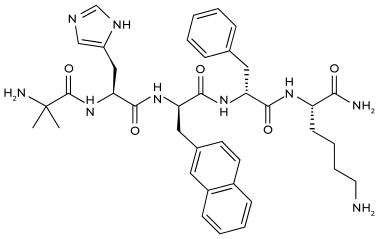
Formula C38H49N9O5 · weight about 712 g/mol · 5 amino acids (sequence Aib-His-D-2-Nal-D-Phe-Lys) [3]

Not FDA-approved; no clear 503A compounding pathway and prohibited for 503B outsourcing facilities; prohibited in sport by WADA

Our most-used and preferred growth-hormone-releasing peptide: clean, gentle, well-rounded, and the one we usually start with. See what we've seen in practice above
Five building blocks, several of them non-standard: Aib (2-aminoisobutyric acid), 2-naphthylalanine, and the two highlighted mirror-image "D" amino acids. Those unusual pieces are what make ipamorelin both stable and highly selective.
Where IPAMORELIN comes from
By the late 1990s, researchers had a family of peptides that could make the pituitary release growth hormone, but they shared a problem: they were not tidy. Along with growth hormone, they tended to raise other hormones such as cortisol and prolactin, and they stimulated appetite. The search was on for one that would do the job cleanly, releasing growth hormone and nothing else.
Ipamorelin was the answer. Developed at Novo Nordisk, it was described in a landmark 1998 paper as the first selective growth hormone secretagogue, a peptide that triggered growth hormone with the potency of its cousins but without the rise in stress hormones that came with them. That selectivity is not a marketing gloss; it is the specific, documented property that defined ipamorelin from the start, and it is the reason it went on to become the most widely used peptide of its kind.
How IPAMORELIN works

.svg)
Ipamorelin binds the ghrelin receptor, also called the growth hormone secretagogue receptor, in the pituitary and hypothalamus, and sets off a pulse of the body's own growth hormone. That pulse raises IGF-1, the messenger behind much of growth hormone's effect. It is a releaser, not a replacement. [1]

.svg)
Unlike the stronger peptides in its family, ipamorelin drives growth hormone without meaningfully raising cortisol, ACTH, or prolactin, and with little effect on appetite. That clean, single-target action is what the 1998 research established and what makes ipamorelin easier to tolerate. [1]
.svg)
Growth hormone is released in pulses, the largest during deep sleep. Given at night on a regular basis, ipamorelin does not just add a pulse; in our experience it helps the body time its own rhythm, with an effect that accumulates over weeks. Being gentle, it works with that rhythm rather than overriding it.
Strong foundational pharmacology, honest about the limits of the long-term evidence[1,2]
What the research shows
Here is the whole picture, told plainly, including a point of honesty about the evidence. Ipamorelin has excellent foundational science for one specific thing, and thinner evidence for the wellness uses it is marketed for.
The foundational work is genuinely strong. The 1998 study that introduced ipamorelin showed clearly, in humans, that it releases growth hormone selectively, without the cortisol and prolactin rise that its cousins cause. That is the finding everything else builds on, and it holds up. Ipamorelin's one real programme of human clinical development was in postoperative ileus, speeding the return of gut function after bowel surgery. A placebo-controlled phase 2 trial found it well tolerated but no better than placebo on its main measure, and the programme went no further. That is the honest state of the human record, and it is worth saying plainly given how often this peptide is described as clinically validated. [1,2]
Now the honest part. Beyond that foundation, the direct evidence for ipamorelin's popular uses, the body-composition, sleep, and anti-aging benefits, is limited: small studies, short follow-up, and a good deal of reasoning from what growth hormone does rather than from long-term trials of ipamorelin itself. We will also note plainly that several specific human trials are commonly cited for ipamorelin that we could not verify in the medical literature, so we have left them out rather than repeat claims we cannot stand behind. The honest description of ipamorelin is "a genuinely selective growth hormone releaser with strong foundational pharmacology and limited long-term outcome data," and that is how we present it.
Selective GH release
Foundational human pharmacology (Raun 1998)
Releases growth hormone without raising cortisol or prolactin
Foundational, not an outcome trial [1]
Human clinical program
Postoperative-ileus development (discontinued)
Real human testing of the molecule
Did not reach approval [2]
Body composition, sleep, recovery
Small studies + GH physiology + practice experience
Effects consistent with growth hormone's known actions
Limited; large long-term trials lacking
Bone, skin
Preclinical and indirect
Follows from IGF-1 and GH biology
Not established in trials
The evidence, area by area
The blue tier is real human data on the core GH-release action; the wellness uses lean on practice experience and physiology.
Ipamorelin's selectivity is also what makes it, at appropriate doses, one of the better-tolerated peptides in its family. The most common thing people notice is minor and harmless: a brief flush and tingle shortly after an injection that passes on its own within a few minutes. That is expected and not a cause for concern.
The one caution that matters most: Dosing
Ipamorelin is clean at sensible, conservative doses, but it does not stay clean if it is pushed harder. Above appropriate doses, the risk of a genuine allergic reaction rises, and those can range from hives and flushing to throat tightness in the direction of anaphylaxis. Dr. Koniver has seen providers and pharmacies dose ipamorelin too aggressively, and this is exactly the setting where an otherwise gentle peptide becomes risky. The lesson is simple: conservative, physician-supervised dosing is what keeps ipamorelin safe, and more is not better here.
Beyond that, the usual growth-hormone-axis cautions apply. Because it raises growth hormone and IGF-1, ipamorelin is avoided in anyone with an active or prior hormone-sensitive cancer, and it can affect blood sugar, so people with diabetes should be monitored. It is not used in pregnancy or breastfeeding, or in people with pituitary disorders. And because unapproved product quality varies, ipamorelin should come through a legitimate pharmacy rather than an unregulated supplier.
Regulatory status
The following is descriptive, not advice. Regulatory status changes; the date below is when we last checked, and ipamorelin's status is unusually specific right now.
In the United States, ipamorelin's compounding status splits by pathway. The two forms of compounding are on different tracks.
Regulatory information current as of 12 August 2026.
503A compounding
pharmacies
NO CLEAR PATHWAY
Ipamorelin came off the FDA's Category 2 restricted list on 22 April 2026, when the nomination behind it was withdrawn. That removed a specific prohibition, but it did not create permission. To be compounded under 503A a substance needs a pharmacopoeial monograph, or to be a component of an approved drug, or a place on the 503A bulks list, and ipamorelin has none of the three. It is also not among the substances the FDA has said it does not intend to act on while it finishes its review. The honest description is that it sits in limbo, awaiting a decision.
503B outsourcing facilities
Prohibited
Still on the Category 2 list for 503B facilities, where compounding it is not allowed. Confirm the current position before acting.
The FDA has set out why it keeps ipamorelin restricted for outsourcing facilities. It points to the risk of immunogenicity from aggregation or peptide-related impurities by certain routes, to the difficulty of characterising a peptide containing unnatural amino acids, and to published serious adverse events, including deaths, when ipamorelin was given intravenously to improve gut motility after surgery. It also says plainly that it has not identified safety information for certain other injectable routes, and so does not know whether harm would follow. That last sentence is the honest centre of the matter, and it is the reason we treat dosing discipline as the main caution on this peptide.
IN COMPETITIVE
SPORT
Prohibited
Banned by WADA at all times, in and out of competition, as a growth hormone secretagogue (S2), and detectable on testing.[4]
IPAMORELIN, answered plainly
It is a synthetic peptide of five amino acids that signals the pituitary to release a pulse of your own growth hormone. It is the most selective of the growth-hormone-releasing peptides, meaning it raises growth hormone without dragging up cortisol, prolactin, or appetite the way some others do.
Because it is clean and gentle. Its selectivity means fewer side effects, and its modest, well-targeted pulse suits most people better than a stronger, messier one. For growth hormone support, it is usually the best place to start, and it pairs well with CJC-1295.
In our experience it supports leaning out, a bit of lean muscle, deeper sleep, better recovery, and durability as you age, gradually rather than dramatically. The foundational science that it selectively releases growth hormone is solid; the direct long-term trials for these specific wellness benefits are limited, and we say so.[1]
At sensible, supervised doses it is one of the better-tolerated peptides in its family, with a common harmless flush-and-tingle after injection. The important caution is dosing: pushed above appropriate doses, it carries a real risk of allergic reactions, so conservative, physician-supervised dosing matters. The usual cautions around cancer history and blood sugar apply as well.
No. It is prohibited by WADA at all times and is detectable on testing. The regulatory section above has the specifics.[4]
Related in this directory


References
- Raun K, Hansen BS, Johansen NL, et al. Ipamorelin, the first selective growth hormone secretagogue. European Journal of Endocrinology. 1998;139(5):552-561. PMID 9849822. (Foundational; selective GH release without cortisol or ACTH rise.)
- Ipamorelin was studied in human clinical development for postoperative ileus (speeding gut recovery after surgery); the program did not lead to approval. Beck DE, Sweeney WB, McCarter MD; Ipamorelin 201 Study Group. Prospective, randomized, controlled, proof-of-concept study of the ghrelin mimetic ipamorelin for the management of postoperative ileus in bowel resection patients. International Journal of Colorectal Disease. 2014;29(12):1527-1534. PMID 25331030. ClinicalTrials.gov NCT00672074. (Phase 2, placebo-controlled, 114 patients analysed; well tolerated, no significant efficacy difference from placebo.)
- PubChem. Ipamorelin (CID 9831659): molecular formula C38H49N9O5, weight about 712 g/mol, sequence Aib-His-D-2-Nal-D-Phe-Lys-NH2.
- World Anti-Doping Agency. The Prohibited List, S2 (peptide hormones, growth factors), growth hormone secretagogues, prohibited at all times.
- US FDA. Ipamorelin compounding status as of 22 April 2026: withdrawn from Category 2 for 503A compounding pharmacies; still Category 2 for 503B outsourcing facilities. Confirm current status before acting.
- Koniver C. The Koniver Method - clinical training for physicians, nurse practitioners and physician assistants (peptide modules). Statements attributed to Dr. Koniver and to the Koniver Wellness practice reflect clinical observation and teaching.
This page is for informational and educational purposes and does not constitute medical advice, diagnosis, or treatment. It is not a substitute for consultation with a qualified healthcare provider. Ipamorelin is not approved by the FDA or any national health authority for therapeutic use and is prohibited in competitive sport. Statements describing how Dr. Koniver and the Koniver Wellness team use and view ipamorelin, including the dosing-safety caution described, reflect clinical experience and judgment, which is not the same as controlled clinical evidence. Regulatory information on this page is provided for general awareness, is current as of the date shown, and may have changed; verify with official sources or a licensed practitioner in your jurisdiction before making any decision. Koniver Wellness serves a worldwide readership: the availability and regulatory status of the therapies discussed vary by country and region, so please check the laws and regulations of your own jurisdiction and consult a licensed local practitioner before pursuing any therapy. Therapies described on this site are prescribed and supervised by licensed physicians for Koniver Wellness patients. Use of this site does not create a physician-patient relationship.
INTERESTED IN PEPTIDES?
START WITH THE RIGHT QUESTIONS.
Understand what peptides can and cannot do, what the evidence actually says, and whether physician-guided peptide therapy makes sense for you.