
Hexarelin
What We've Seen in Practice, and What the Research Says
Hexarelin is a growth hormone peptide, but it does not contain any growth hormone. It is a short synthetic chain of six amino acids that signals the pituitary gland to release a pulse of the body's own growth hormone. In that sense it belongs to the same family as several other peptides in this directory, the ones that nudge your own hormone production rather than replacing it. Hexarelin is one of the older and more potent members of that family, first studied in the 1990s.
Within that family, hexarelin has a particular reputation: it leans toward energy and endurance rather than muscle bulk. That is how we have thought of it, and it is a real distinction we will explain. But hexarelin also comes with a caution that matters more than any of its benefits, and because it is a safety point rather than a marketing one, we are going to put it near the front rather than bury it.
So this page does two things. It explains honestly what hexarelin is and what the research actually shows, human and preclinical, and it tells you plainly why, despite its interesting profile, it is a peptide we use very little of today.

What we've seen in practice
Hexarelin sits in the growth-hormone-releasing family, and each peptide in that family has its own character. Ipamorelin is the clean, well-rounded one we reach for first. Others lean toward building muscle. Hexarelin, in our experience, leans the other way, toward energy and endurance, which made it an appealing morning option for endurance athletes looking for a steadier kind of long-term energy rather than size. On paper, it filled a nice niche.
In practice, though, we have pulled back from it, and the reason is a safety one we take seriously. Over time we saw a meaningful number of patients react to hexarelin, and not only at higher amounts. Some developed hives and a tight throat even at low doses, and a few progressed toward shortness of breath. Those are allergic-type reactions, and they are not something to push through. Dr. Koniver's position is that hexarelin has to be treated with a great deal of respect, that it is not a peptide to experiment with casually, and that for most people the risk-to-benefit math simply does not favor it when calmer options exist.
There is a practical layer on top of the safety one. Hexarelin has also become harder to find and harder to source reliably, which matters for a peptide where product quality and purity are already a concern. Between the reaction risk and the sourcing, hexarelin has moved to the edge of what we do rather than the center of it. There is also a limit built into the molecule. In the one study that followed adults on hexarelin for sixteen weeks, the growth hormone response faded as the course went on and recovered after it stopped, and over that period there was no measurable change in IGF-1, body fat, lean mass or bone density. The response is real, in other words, but sustaining it is a different question from producing it.
None of that makes hexarelin uninteresting. It has genuine science behind it, and we will lay that out. It does mean our honest clinical read is a cautious one: we know it, we respect it, and we use very little of it, preferring the cleaner members of the same family for most people.
The research behind these observations, including where it is solid and where it is thin, follows below.
Hexarelin at a glance

A synthetic peptide of six amino acids that signals the pituitary to release the body's own growth hormone; one of the older, more potent growth-hormone-releasing peptides [6]
.svg)
Growth hormone release, body composition, and (separately, mostly in animals) heart protection and anti-inflammatory effects [1, 2]
.svg)
Genuine human studies of its growth-hormone effect (1990s onward); cardiac and lung effects largely preclinical; never approved [1, 2]
.svg)
By injection in the research literature
.svg)
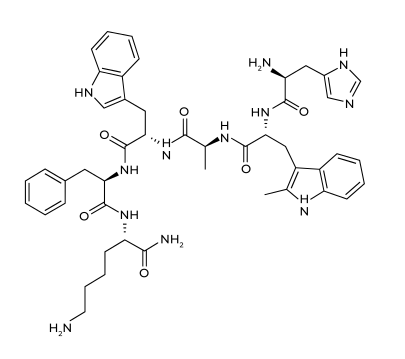
Formula C47H58N12O6 · weight 887 g/mol · 6 amino acids (sequence His-D-2-methyl-Trp-Ala-Trp-D-Phe-Lys) [6]

Not FDA-approved; not part of the 2026 peptide-compounding decisions; prohibited in sport by WADA at all times

We think of it as the endurance-leaning member of the growth-hormone-peptide family, but we use very little of it because of low-dose allergic-type reactions and sourcing concerns. See what we've seen in practice above
Six amino acids. The two highlighted residues (D-2-methyl-Trp and D-Phe) are mirror-image "D" amino acids that the body's enzymes break down more slowly, which is part of what makes hexarelin potent.
Where hexarelin comes from
Your pituitary gland releases growth hormone in pulses, and it does so partly in response to a natural appetite-and-growth signal called ghrelin. In the 1990s, researchers built a family of small synthetic peptides that imitate that signal, binding the same receptor to trigger a pulse of growth hormone on demand. These became known as growth-hormone-releasing peptides. Hexarelin was one of the most potent of the early ones.
The interest at the time was practical. Injected growth hormone was effective but blunt, and a peptide that coaxed the body to make its own, in its own natural pulse, looked like a gentler approach to age-related hormone decline. Hexarelin was studied clinically for exactly that, and it clearly worked at raising growth hormone. It never became an approved medicine, though, and one reason is worth knowing: with continuous daily use the growth hormone response tends to fade, as the system adjusts to constant stimulation. That is a general feature of this peptide class, and it shaped how these compounds are used.
How hexarelin works

.svg)
Hexarelin binds the growth hormone secretagogue receptor, the same one ghrelin uses, in the hypothalamus and pituitary. That sets off a pulse of the body's own growth hormone, which in turn raises IGF-1. It is a releaser, not a replacement.[1]

.svg)
Hexarelin binds a second, different receptor called CD36 in cardiac tissue. Through CD36 it has shown protective effects on the heart in laboratory and animal studies, and those effects appear to be independent of growth hormone entirely.[1]
.svg)
Like other peptides in its family, hexarelin's growth-hormone response attenuates if it is used continuously, as the receptor adapts. That self-limiting quality is part of the peptide's character and part of why these compounds were studied in cycles.
Real human evidence for one thing (raising GH); the rest is promising but preclinical [1, 2]
What the research shows
Here is the whole picture, told plainly. Hexarelin has real human evidence for one thing, raising growth hormone, and mostly preclinical evidence for the rest.
The solid, human part is the growth hormone effect. Studies going back to the 1990s, including in older adults, showed that hexarelin reliably raises growth hormone when given, with the response larger in leaner people. That much is well established. The more exciting-sounding claims, the heart protection and the anti-inflammatory and lung-protective effects, come mostly from cell and animal work. The cardiac line in particular is scientifically interesting, because it runs through the CD36 receptor rather than growth hormone, but it has not been carried into large human trials. And hexarelin was never approved as a medicine anywhere.[1, 2, 5]
So the honest description of hexarelin is "a growth hormone releaser with solid human evidence for that one effect, a promising but still-preclinical second life in cardiac biology, and no approval behind any of it." We are careful not to let the animal cardiac results read as established human treatments.
Growth hormone release
Human studies (1990s onward)
Reliably raises the body's own growth hormone; larger response in leaner people
Not approved; response fades with continuous use [2]
Cardiac protection
Cell and animal models (via CD36)
Protective effects on heart tissue, independent of growth hormone
Preclinical; no large human trials [1]
Anti-inflammatory / lung
Animal models
Reduced injury and inflammation markers
Animal only; human translation needed [5]
Body composition
Limited human + preclinical
Effects tied to the growth hormone rise
Limited; entangled with the GH response
The evidence, area by area
Tiers on this page: Human studies · Animal research only · Clinical observation (our practice). The green chip here reflects sparing, cautious use, not enthusiasm.
Our most important caution: We are putting the most important point first, because our clinical experience differs from the reassuring picture some sources paint. In our practice, a meaningful number of patients have had allergic-type reactions to hexarelin, and not only at higher doses. We have seen hives and throat tightness at low doses, and in a few cases progression toward shortness of breath. Reactions like those are the reason Dr. Koniver treats hexarelin with real caution and uses very little of it. If you and a clinician ever consider it, this is a peptide that calls for careful, supervised, low-and-slow testing rather than casual use, and any sign of an allergic reaction is a reason to stop.
Beyond that, the ordinary growth-hormone-axis cautions apply. Because it drives the growth hormone and IGF-1 system, hexarelin is avoided in anyone with an active or prior cancer, given growth signaling's theoretical role there, and it can affect blood sugar, so it calls for monitoring in people with diabetes. Pregnancy and breastfeeding are exclusions. And hexarelin is unapproved and variable in commercial quality, so product sourced outside regulated channels carries a real purity and identity risk on top of everything else.
Regulatory status around the world
This section describes status only. It is not legal or medical advice, and availability rules change.
Verify anything that matters with official sources or a licensed practitioner where you live.
Regulatory information current as of 12 August 2026.
As a medicine,
worldwide
Not an approved medicine in any country. It was studied clinically decades ago but never approved.
In competitive sport
Prohibited
Banned by WADA at all times, in and out of competition, as a growth hormone secretagogue (S2), and detectable on testing.[7]
United States
Never FDA-approved. Not among the peptides removed from Category 2 in April 2026, those recommended in July 2026, or the group scheduled for review in early 2027. An unapproved, hard-to-source peptide.
Hexarelin, answered plainly
It is a synthetic peptide of six amino acids that tells the pituitary gland to release a pulse of your own growth hormone. It belongs to the growth-hormone-releasing peptide family and is one of the older, more potent ones, first studied in the 1990s.
For raising growth hormone, yes, and that part is human-tested: it reliably produces a growth hormone pulse. Its other advertised benefits, especially the heart-protective ones, are mostly from animal studies and have not been confirmed in large human trials. And it was never approved as a medicine.[2]
Mainly safety. We have seen allergic-type reactions to it, including hives, throat tightness, and occasionally shortness of breath, sometimes even at low doses. That risk, plus the fact that it is hard to source reliably, is why Dr. Koniver treats it with a lot of respect and reaches for cleaner peptides in the same family for most people.
It has to be approached cautiously. The allergic-type reactions above are the main concern, and there are the usual growth-hormone-axis cautions around cancer history and blood sugar. It is not a peptide to use casually or without supervision, and unregulated product quality is a separate, real risk.
No. It is prohibited by WADA at all times and is detectable on testing. The regulatory status section above has the specifics.[7]
Related in this directory


References
- Bodart V, Febbraio M, Demers A, et al. CD36 mediates the cardiovascular action of growth hormone-releasing peptides in the heart. Circulation Research. 2002;90(8):844-849. PMID 11988484. (Cardiac CD36 mechanism, growth-hormone-independent.)
- Ghigo E, Arvat E, Gianotti L, et al. Growth hormone-releasing activity of hexarelin, a new synthetic hexapeptide, after intravenous, subcutaneous, intranasal, and oral administration in man. The Journal of Clinical Endocrinology and Metabolism. 1994;78(3):693-698. PMID 8126144. (Human growth hormone release across routes of administration.)
- Rahim A, O'Neill P, Shalet SM. The effect of body composition on hexarelin-induced growth hormone release in normal elderly subjects. Clinical Endocrinology. 1998;49(5):659-664. PMID 10197083. (Human growth hormone response in older adults.)
- Rahim A, O'Neill PA, Shalet SM. Growth hormone status during long-term hexarelin therapy. The Journal of Clinical Endocrinology and Metabolism. 1998;83(5):1644-1649. PMID 9589671. (Growth hormone response over sustained use.)
- Zambelli V, Rizzi L, Delvecchio P, et al. Hexarelin modulates lung mechanics, inflammation, and fibrosis in acute lung injury. Drug Target Insights. 2021;15:26-33. PMID 34871336. (Mouse model of acid-induced lung injury; preclinical anti-inflammatory work.)
- PubChem. Hexarelin / Examorelin (CID 6918297): molecular formula C47H58N12O6, weight 887 g/mol, sequence His-D-2-methyl-Trp-Ala-Trp-D-Phe-Lys-NH2.
- World Anti-Doping Agency. The Prohibited List, S2 (peptide hormones, growth factors), growth hormone secretagogues, prohibited at all times.
- US FDA. Hexarelin is not FDA-approved and was not among the April 2026 Category 2 removals, the July 2026 advisory-committee recommendations, or the group scheduled for review in early 2027.
- Koniver C. The Koniver Method - clinical training for physicians, nurse practitioners and physician assistants (peptide modules). Statements attributed to Dr. Koniver and to the Koniver Wellness practice reflect clinical observation and teaching.
This page is for informational and educational purposes and does not constitute medical advice, diagnosis, or treatment. It is not a substitute for consultation with a qualified healthcare provider. Hexarelin is not approved by the FDA or any national health authority for therapeutic use and is prohibited in competitive sport. Statements describing how Dr. Koniver and the Koniver Wellness team have used and view hexarelin, including the allergic-type reactions described, reflect clinical experience and judgment, which is not the same as controlled clinical evidence. Regulatory information on this page is provided for general awareness, is current as of the date shown, and may have changed; verify with official sources or a licensed practitioner in your jurisdiction before making any decision. Koniver Wellness serves a worldwide readership: the availability and regulatory status of the therapies discussed vary by country and region, so please check the laws and regulations of your own jurisdiction and consult a licensed local practitioner before pursuing any therapy. Therapies described on this site are prescribed and supervised by licensed physicians for Koniver Wellness patients. Use of this site does not create a physician-patient relationship.
INTERESTED IN PEPTIDES?
START WITH THE RIGHT QUESTIONS.
Understand what peptides can and cannot do, what the evidence actually says, and whether physician-guided peptide therapy makes sense for you.