
SS-31
The Mitochondrial Peptide That Became a Medicine
SS-31, known in medicine as elamipretide, is a small four-amino-acid peptide that concentrates inside mitochondria and protects cardiolipin, the fat molecule that holds their inner machinery together. Think of it as maintenance for the power plants of your cells.
It holds two distinctions in this directory. It is one of three mitochondrial peptides we actively use, stacked with NAD and humanin. And in September 2025 it quietly made history: the FDA approved it as the first-ever therapy for Barth syndrome, a rare genetic mitochondrial disease.
.svg)

What we have seen in practice
SS-31 is the third member of our mitochondrial family, alongside MOTS-c and humanin, and it earns its place by working somewhere the others do not. Dr. Koniver teaches it this way: SS-31 works on cardiolipin, a molecule woven into the mitochondrial membrane at the cytochrome c oxidase hub, the same hub where methylene blue acts. That location matters, because it is where, in his words, the mitochondria decides its fate: break down and be recycled, or become more fit and make more energy. Supporting that decision point is the job. In his cellular-energy teaching he puts it simply: SS-31 helps ensure the architecture of the mitochondria stays intact.
In day-to-day use it has been an easy peptide to work with. It is very well tolerated, given by subcutaneous injection, and in earlier years we also ran it intravenously. One honest observation from that experience: it does seem to cause a little fluid retention in some people. Dr. Koniver also notes with interest that neurologists have begun exploring SS-31 in neurodegenerative conditions like Parkinson's and ALS - an observation about where the field is heading, not a claim we make for it.
Today SS-31 is part of a combination we actively offer: NAD plus humanin plus SS-31, the full mitochondrial stack. Mixing NAD with these mitochondrial peptides seems to work quite well, and SS-31 brings the membrane-architecture piece the others do not. His candid comparison: it is not the same as MOTS-c, his favorite of the family, but it has been the dependable, available workhorse of the three, with a genuine case that it helps mitochondria stay fit.
SS-31 at a glance

A four-amino-acid, mitochondria-targeted peptide (elamipretide) that binds and protects cardiolipin, the key fat molecule of the inner mitochondrial membrane [1, 2]
.svg)
Mitochondrial support: cellular energy, resilience, and healthy-aging protocols; in medicine, the first approved treatment for Barth syndrome
.svg)
Rare for this directory: real randomized human trials, honestly mixed - a failed large trial in mitochondrial myopathy, and a successful ultra-rare-disease program that led to a 2025 FDA approval [4, 5, 6]
.svg)
By subcutaneous injection; intravenously in some settings
.svg)
D-Arg-Dmt-Lys-Phe-NH2, formula C32H49N9O5, about 639.8 g/mol [6]

FDA-approved (accelerated) for Barth syndrome as Forzinity since September 2025; not approved for anything else; not listed by WADA. Details below

Part of the mitochondrial stack we currently offer: NAD + humanin + SS-31. See what we have seen in practice above
Pink bead = dimethyltyrosine (Dmt), the engineered antioxidant amino acid that gives the SS peptides their scavenging character. The chain ends in an amide (NH2) cap.
Dmt-D-Arg-Dmt-Lys-NH2
D-Arg-Dmt-Lys-Phe-NH2
C20H32N8O5 · 464.5
C32H49N9O5 · 639.8
Verified against the primary chemical databases and recomputed by hand. The commonly published formula describes a different molecule.
Where SS-31 comes from
SS-31 was designed, not discovered. In the early 2000s, pharmacologists Hazel Szeto and Peter Schiller built a series of small "SS" peptides with an unusual talent: they pass into cells and concentrate a thousandfold at the inner mitochondrial membrane, carrying an engineered antioxidant amino acid to the one place oxidative damage does the most harm. The 2004 paper introducing them showed these peptides prevented mitochondrial swelling, protected cytochrome c, and reduced oxidative cell death.
The fourth of the series, SS-31, went on to a serious pharmaceutical career under the name elamipretide. Its defining discovery came in 2013: SS-31 binds cardiolipin, the distinctive phospholipid of the inner mitochondrial membrane, and by protecting it, re-energizes damaged mitochondria. Cardiolipin holds the respiratory machinery in working formation; guard the cardiolipin and you guard the power plant. That mechanism carried elamipretide into human trials in mitochondrial disease, heart failure, eye disease, and ultimately to a first-of-its-kind approval.
Targets the inner membrane
Cardiolipin
Re-energized mitochondria
How it works

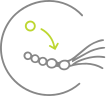
SS-31's cationic, aromatic structure draws it selectively into mitochondria, where it concentrates at the inner membrane - the site of energy production, and the site where oxidative damage is most costly. [1]

.svg)
Cardiolipin anchors the respiratory complexes, holds cristae in their folded architecture, and partners with cytochrome c. SS-31 binds it and protects it from peroxidation, preserving the structures that turn food and oxygen into ATP. [2]
.svg)
With cardiolipin protected, the electron transport chain stays organized and efficient: more ATP, fewer escaped electrons, less reactive-oxygen stress - the precise version of keeping the mitochondrial architecture intact. [1, 2]
A real human trial record, honestly mixed - and that is exactly why the approval means something.
What the research shows
SS-31 has something almost nothing else in this directory has: a genuine randomized human trial record. We report it honestly, because it points in two directions.
The hard result first. In MMPOWER-3, the pivotal trial in primary mitochondrial myopathy - 218 patients, six months, randomized and placebo-controlled - elamipretide did not beat placebo on either primary endpoint: six-minute walk distance or fatigue. The trial was well run, the drug was well tolerated, and the answer for that population, on those endpoints, was no. An earlier short crossover trial had shown encouraging signals, which is exactly why the definitive trial mattered. We include this because a directory you can trust has to report the trials that failed.
Then the result that made history. In Barth syndrome, an ultra-rare genetic disease of cardiolipin metabolism - the very molecule SS-31 protects - the TAZPOWER program showed improvements in muscle strength, walking distance, and fatigue that accumulated over years. On the strength of the knee-extensor data, the FDA granted accelerated approval in September 2025: Forzinity, the first therapy ever approved for Barth syndrome, with confirmatory evidence still required. It is a narrow approval in a tiny population, and it is also the moment this "wellness peptide" became a real medicine.
Mechanism (cardiolipin, inner membrane)
Foundational lab studies
Selective mitochondrial targeting; cardiolipin protection restores energetics
Well established [1, 2]
Barth syndrome
Randomized crossover + long extension; FDA review
Strength and function gains; first-ever approved therapy (2025)
Approved, accelerated; confirmation ongoing [5, 6]
Primary mitochondrial myopathy
Pivotal 218-patient randomized trial
Did not meet primary endpoints
A clear, honest no [4]
General wellness and healthy aging
Mechanism, small studies, practice experience
Plausible mitochondrial support; not trial-settled
Clinical observation territory
How strong is the evidence
The human trial program is the best safety witness this directory has for any research peptide: across the mitochondrial myopathy and Barth studies, elamipretide was consistently well tolerated, with injection-site reactions the most common complaint. Even the trial that failed on efficacy was clean on safety.
Our experience matches: very well tolerated, with one honest practice-side note - a little fluid retention in some people, something we watch for and the kind of detail a directory should share. Standing rules apply: physician screening rules out active malignancy, we avoid it in pregnancy and breastfeeding, and product quality matters - especially now that an approved pharmaceutical version exists for one disease while the wellness market runs on compounded and research-grade material.
Regulatory status
Regulatory information current as of 13 August 2026.
This is a summary, not legal or medical advice, and status can change
Sport (WADA)
Not named
Not named on the WADA Prohibited List. Competing athletes should verify current status with their governing body, as lists change annually.
United States
FDA-APPROVED - BARTH SYNDROME (2025)
Accelerated approval 19 September 2025: Forzinity (elamipretide), the first therapy for Barth syndrome, for patients weighing at least 30 kg; confirmatory evidence required. Not approved for any other use. Wellness SS-31 is compounded or research-market material, not the approved product, and copies of approved medicines face restrictions. Never on the 2023 restricted compounding list.
Everywhere else
The Barth approval is a US decision; elsewhere elamipretide remains investigational, and products sold outside licensed channels carry the quality risks described in the safety section.
Common questions
A small, four-amino-acid peptide (elamipretide) engineered to concentrate inside mitochondria and protect cardiolipin, the fat molecule that keeps the inner mitochondrial membrane and its energy machinery organized.
For one disease, yes: since September 2025, elamipretide (Forzinity) is approved for Barth syndrome, an ultra-rare genetic mitochondrial disease - the first therapy ever approved for it. For everything else, including general wellness use, it is not approved; the regulatory section above has the details.
All three are mitochondrial peptides, and we use them as a family. MOTS-c leans toward metabolism and fitness signaling, humanin toward cell-survival and longevity pathways, and SS-31 works on the structure itself: protecting cardiolipin so the energy machinery stays organized. In our practice, SS-31 joins NAD and humanin in a combination we currently offer.
Yes, and we say so plainly: the pivotal trial in primary mitochondrial myopathy (218 patients) did not meet its primary endpoints. The same molecule then earned approval in Barth syndrome, where its cardiolipin mechanism meets the disease's root cause. Both results are part of the honest picture. [4, 5, 6]
It is not named on the WADA Prohibited List. Competing athletes should still confirm current status with their governing body.
Related peptides


References
- Zhao K, Zhao GM, Wu D, et al. Cell-permeable peptide antioxidants targeted to inner mitochondrial membrane inhibit mitochondrial swelling, oxidative cell death, and reperfusion injury. J Biol Chem. 2004;279(33):34682-34690. PMID 15178689.
- Birk AV, Liu S, Soong Y, et al. The mitochondrial-targeted compound SS-31 re-energizes ischemic mitochondria by interacting with cardiolipin. J Am Soc Nephrol. 2013;24(8):1250-1261. PMID 23813215.
- Karaa A, Haas R, Goldstein A, et al. A randomized crossover trial of elamipretide in adults with primary mitochondrial myopathy. Neurology. 2020;94(7):e687-e698. PMID 32096613.
- Karaa A, Bertini E, Carelli V, et al. Efficacy and Safety of Elamipretide in Individuals With Primary Mitochondrial Myopathy: The MMPOWER-3 Randomized Clinical Trial. Neurology. 2023;101(3):e238-e252. PMID 37268435.
- Thompson WR, Manuel R, Abbruscato A, et al. Long-term efficacy and safety of elamipretide in patients with Barth syndrome: 168-week open-label extension results of TAZPOWER. Genet Med. 2024;26(7):101138. PMID 38602181.
- US Food and Drug Administration. Accelerated approval of FORZINITY (elamipretide HCl) for Barth syndrome, NDA 215244, 19 September 2025. Molecular data: elamipretide, PubChem CID 11764719, formula C32H49N9O5, molecular weight ~639.8 g/mol.
- Koniver C. The Koniver Method - clinical training for physicians, nurse practitioners and physician assistants (peptide modules). Statements attributed to Dr. Koniver and to the Koniver Wellness practice reflect clinical observation and teaching.
This page is for informational and educational purposes and does not constitute medical advice, diagnosis, or treatment. Elamipretide is FDA-approved only for Barth syndrome; all other uses, including wellness applications of SS-31, are not approved, and compounded or research-market SS-31 is not the approved pharmaceutical product. Statements describing how Dr. Koniver and the Koniver Wellness team use SS-31 reflect clinical experience and judgment, which is not the same as controlled clinical evidence. Nothing here is a substitute for consultation with a qualified healthcare provider. Peptide therapy at Koniver Wellness is provided under physician supervision after appropriate screening, and the availability of any given peptide depends on its regulatory and supply status.
INTERESTED IN PEPTIDES?
START WITH THE RIGHT QUESTIONS.
Understand what peptides can and cannot do, what the evidence actually says, and whether physician-guided peptide therapy makes sense for you.