
HUMANIN
What We've Seen in Practice, and What the Research Says
Humanin is one of the more remarkable molecules in this directory, and the reason is where it comes from. Most peptides are pieces of proteins your cells build from instructions in the nucleus. Humanin is different: it is written into the DNA of your mitochondria, the tiny power plants inside your cells, and it was the first such peptide ever found. That origin is not just trivia. It places humanin at the intersection of energy, aging, and cellular survival, which is exactly where the research has focused.
It was discovered in an unexpected place. Scientists studying the brains of people who had died with Alzheimer's disease found a small peptide that seemed to protect neurons from the damage the disease causes, and they named it humanin. Since then it has been studied for far more than the brain: for metabolism, for the heart, and for aging itself, where one of its most interesting features is simple. The amount of humanin your body carries falls as you get older, and people who carry more of it, or a particular longevity-linked version of it, tend to live longer.
We use humanin, and we will be candid about how. It is a quiet peptide, not a dramatic one, and it fits a specific role in a longevity plan rather than producing an effect you feel. That honesty is where
we will start.

What we've seen in practice
Humanin belongs to a small family of what are called mitochondrial peptides, made by the mitochondria themselves. Two others in that family are MOTS-c and SS-31. Where MOTS-c leans toward fitness and performance, humanin leans the other way, toward DNA repair and recovery, which is why Dr. Koniver thinks of it as a longevity peptide rather than a performance one.
Here is the honest part, and we lead with it because it shapes everything about how we use humanin: most people do not feel it. A few describe a smooth, clean sort of energy, but for the majority there is no obvious sensation, and we would rather tell you that plainly than imply otherwise. Dr. Koniver describes humanin as more of an insurance policy, a background peptide working at the level of cellular repair and resilience, not a peptide you take to feel different that afternoon. If you want something you notice, humanin is not it. If you want a quiet contributor to a longevity plan, it fits.
The way we use it reflects that. Humanin pairs naturally with NAD, another cornerstone of the longevity and mitochondrial work we do, and we most often provide it as a combination, NAD together with humanin, as a convenient at-home injection for our patients. For some people we extend that to a three-part combination of NAD, humanin, and SS-31, another mitochondrial peptide. Mixing these mitochondrial tools with NAD has worked well in our hands, and humanin earns its place in that stack as the DNA-repair-and-longevity component.
One practical note. Humanin remains available to be compounded, which is not true of every peptide in this directory. So unlike some of the peptides we have written about losing, humanin is one we still reach for today.
The research behind these observations, including where it is strong and where it stops, follows below.
HUMANIN at a glance

The first known mitochondrial-derived peptide: a 24-amino-acid peptide encoded in mitochondrial DNA, involved in cell survival, metabolism, and aging [1, 5]
.svg)
Neuroprotection, metabolic health and insulin sensitivity, cardiovascular protection, and longevity [1, 4]
.svg)
Strong and consistent in cells and animals, plus human data linking humanin levels and variants to aging and longevity; no human treatment trials yet [1, 2]
.svg)
By injection in the research literature and in practice, often paired with NAD
.svg)
Formula C119H204N34O32S2 · weight about 2,687 g/mol · 24 amino acids [5]

Not FDA-approved, but remains available through compounding; not specifically listed by WADA

A quiet longevity and DNA-repair peptide we still use, usually combined with NAD; most people do not feel a distinct effect. See what we've seen in practice above

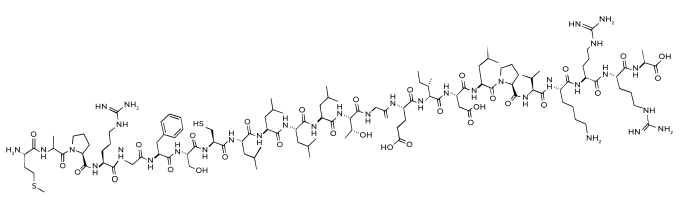
The 24-amino-acid sequence. Because it is encoded in the mitochondria, humanin is made in a different part of the cell from most peptides.
Where HUMANIN comes from
Your cells carry two sets of DNA. Most of it sits in the nucleus, but your mitochondria keep their own small, separate genome, a leftover from their ancient origins as independent organisms. In 2001, researchers looking at surviving brain cells from Alzheimer's patients traced a protective peptide back to that mitochondrial genome, specifically to a region normally thought of as doing something else entirely. That peptide was humanin, and it was the first evidence that the mitochondria write their own signaling molecules, not just the machinery of energy production.
The discovery reframed how scientists think about mitochondria. Rather than being simple batteries, they turned out to send messages to the rest of the cell and the body, and humanin was the first of these messages to be identified. What makes it compelling for aging research is the pattern that emerged next: humanin levels are high in the young and fall with age, and both long-lived animals and long-lived people tend to carry more of it. That has made humanin a favorite subject in longevity science, and it is the frame most of the research below sits inside.
How HUMANIN works

.svg)
At its core, humanin protects cells from dying under stress. It binds and neutralizes the proteins that trigger the cell-death cascade, which is how it protected neurons in the studies that led to its discovery. That anti-cell-death activity underlies most of its other effects. [1, 4]


Humanin acts on a receptor complex on the cell surface that switches on pro-survival signaling inside the cell, and it engages a second receptor system involved in inflammation. Through these it protects tissue, calms inflammatory signaling, and supports cells under stress. [3, 4]
.svg)
As a mitochondrial peptide, humanin helps protect mitochondrial function, and in animal and cell studies it improves insulin sensitivity and protects the insulin-producing cells of the pancreas. These are the metabolic threads of its longevity story. [1]
A coherent preclinical record and real human association data, still lacking a treatment trial [1,2]
What the research shows
Here is the whole picture, told plainly. Humanin has an unusually coherent body of research for a peptide, and it is still missing the one kind of study that would make it a treatment.
From the research: the preclinical case is strong and consistent. Across cells and animals, humanin protects neurons from Alzheimer's-related damage, improves measures of metabolic health, protects the heart in injury models, and, in animals, is tied to longer, healthier lifespans. The human side is genuine but of a different kind: rather than treatment trials, it is association data. Researchers have shown that humanin levels decline with age, track with metabolic and disease markers, and that a specific longevity-linked variant of humanin is more common in people who live longer and appears to resist Alzheimer's-related brain changes. [1, 2, 4]
What does not yet exist is a human trial that gives people humanin and measures whether it changes an outcome. So the honest description of humanin is "a naturally occurring peptide with a strong preclinical record and real human association data, still lacking a human treatment trial." We hold it to that standard, which is part of why we describe its role modestly.
Longevity / aging
Animal lifespan studies + human association data
Longer, healthier lifespan in animals; humanin levels and variants track with human longevity
No human treatment trial [1, 2]
Neuroprotection
Cell and animal models
Protects neurons from amyloid-beta and other insults
Preclinical; human trials needed [1, 4]
Metabolic health
Cell and animal models
Improves insulin sensitivity; protects insulin-producing cells
Preclinical [1]
Cardiovascular
Animal models
Protective in heart-injury and atherosclerosis models
Animal only [1]
The evidence, area by area
The teal chip is real human evidence, but observational (levels and variants), not a treatment trial.
Humanin has a reassuring safety picture as far as it goes. It is a peptide the body makes on its own, it has been well tolerated across preclinical studies, and in our own use it has been well tolerated too, with the honest caveat that its effects are subtle enough that there is little for a patient to react to in the first place.
Two cautions follow from its biology and deserve stating. First, because humanin is fundamentally a cell-survival signal, there is a theoretical reason for caution in anyone with an active or prior cancer, since you do not want to send a broad survival signal in that setting; that is a decision to make carefully with your physician. Second, because humanin can improve insulin sensitivity, it can lower blood sugar, so anyone with diabetes or on glucose-lowering medication should be monitored. Pregnancy and breastfeeding are exclusions where safety data is lacking. And as with any compounded peptide, quality matters: humanin should come through a legitimate pharmacy, not an unregulated research-chemical supplier of unknown purity.
Regulatory status
The following is descriptive, not advice. Regulatory status changes; the date below is when we last checked.
Regulatory information current as of 12 August 2026.
As a medicine,
worldwide
Not an approved medicine in any country. It is used as a compounded peptide under physician supervision, not as an approved drug.
United States
Available via compounding
Never FDA-approved, but unlike several peptides here, humanin was not restricted in the 2023 review and remains available to compound. Not part of the July 2026 or early-2027 decisions.
IN COMPETITIVE
SPORT
Not specifically listed
Humanin is not specifically named on the WADA Prohibited List, and its status for sport is not clearly defined. The list is revised each January; verify before use.[6]
HUMANIN, answered plainly
It is the first known mitochondrial-derived peptide: a 24-amino-acid peptide written into the DNA of your mitochondria rather than the cell nucleus. It acts as a cell-survival signal and has been studied for neuroprotection, metabolic health, and longevity.
Honestly, probably not much. A few people describe a smooth, clean energy, but most feel no distinct effect. We use humanin as a background longevity and DNA-repair peptide, an insurance-policy kind of tool, not something you take to feel different that day.
Almost always with NAD. We most often provide it as an at-home NAD-plus-humanin combination, and for some people as a three-part NAD, humanin, and SS-31 combination. It is the DNA-repair-and-longevity member of that mitochondrial stack.
It has been well tolerated in research and in our practice, and it occurs naturally in the body. The main cautions are a theoretical one around active or prior cancer, because it is a survival signal, and blood-sugar monitoring for anyone with diabetes, since it can improve insulin sensitivity. Product quality matters, so it should come through a legitimate pharmacy.
It is not specifically listed by WADA, but that list changes annually and its sport status is not clearly defined, so any competitor should verify before use. The regulatory section above has the detail.[6]
Related in this directory


References
- Hashimoto Y, Niikura T, Tajima H, et al. A rescue factor abolishing neuronal cell death by a wide spectrum of familial Alzheimer's disease genes and Abeta. Proceedings of the National Academy of Sciences. 2001;98(11):6336-6341. PMID 11371646. (Discovery of humanin.)
- Miller B, Kim SJ, Cohen P, et al. Humanin variant P3S is associated with longevity in APOE4 carriers and resists APOE4-induced brain pathology. Aging Cell. 2024. PMID 38520065. (Human longevity-association data.)
- Takeshita Y, et al. SH3-binding protein 5 mediates the neuroprotective effect of the secreted bioactive peptide humanin. Journal of Biological Chemistry. 2013;288(34). PMID 23861391.
- Hashimoto Y, et al. Involvement of tyrosine kinases and STAT3 in humanin-mediated neuroprotection. Life Sciences. 2005. PMID 16005025.
- PubChem. Humanin (CID 16131438): molecular formula C119H204N34O32S2, weight about 2,687 g/mol, sequence MAPRGFSCLLLLTSEIDLPVKRRA (24 amino acids).
- World Anti-Doping Agency. The Prohibited List (humanin not specifically listed; reviewed annually).
- US FDA. Humanin is not FDA-approved; it was not among the peptides restricted in 2023 and remains available through compounding.
- Koniver C. The Koniver Method - clinical training for physicians, nurse practitioners and physician assistants (peptide modules). Statements attributed to Dr. Koniver and to the Koniver Wellness practice reflect clinical observation and teaching.
This page is for informational and educational purposes and does not constitute medical advice, diagnosis, or treatment. It is not a substitute for consultation with a qualified healthcare provider. Humanin is not approved by the FDA or any national health authority as a therapeutic drug; it is used as a compounded peptide under physician supervision. Statements describing how Dr. Koniver and the Koniver Wellness team use and view humanin reflect clinical experience and judgment, which is not the same as controlled clinical evidence, and no human treatment trial of humanin has been completed. Regulatory information on this page is provided for general awareness, is current as of the date shown, and may have changed; verify with official sources or a licensed practitioner in your jurisdiction before making any decision. Koniver Wellness serves a worldwide readership: the availability and regulatory status of the therapies discussed vary by country and region, so please check the laws and regulations of your own jurisdiction and consult a licensed local practitioner before pursuing any therapy. Therapies described on this site are prescribed and supervised by licensed physicians for Koniver Wellness patients. Use of this site does not create a physician-patient relationship.
INTERESTED IN PEPTIDES?
START WITH THE RIGHT QUESTIONS.
Understand what peptides can and cannot do, what the evidence actually says, and whether physician-guided peptide therapy makes sense for you.