
Semaglutide
The Peptide Behind Ozempic and Wegovy
Semaglutide is an engineered version of GLP-1, a natural gut hormone your body releases after you eat. As the medicine inside Ozempic, Wegovy, and Rybelsus, it steadies blood sugar and quiets appetite, and it has become one of the most widely prescribed medicines in the world.
It is also the most thoroughly studied entry in this directory, with tens of thousands of people in randomized trials. So our clinical observations sit on top of deep evidence, and the honest questions are elsewhere - how fast to lose, how to protect muscle, and how to come off well. That is where our experience does its work.

What we've seen in practice
GLP-1 medicines have a real place at Koniver Wellness. We began with semaglutide years ago, and today we reach predominantly for tirzepatide, its newer cousin, though semaglutide remains the right fit for some of our patients. In Dr. Koniver's words, they are here to stay - they have helped so many patients that they sit right up among the most prescribed medicines anywhere.
The way we use them matters more than the fact that we use them. The early years of this medicine taught the whole field a lesson. Started too aggressively, people lost weight too fast - the gaunt look that got nicknamed after the drug, along with lost muscle and thinning hair. Our answer is to start at a very low amount, raise it slowly if at all, and take our time. There is never an urgency. Dr. Koniver does not like our patients to lose more than about two pounds a week, and with that pace and close follow-up, what we see is people who keep their muscle, keep their hair, keep good energy, and still lose the weight. Some people are more sensitive to these medicines and can overshoot.
Dr. Koniver is just as candid about the exit as the entrance. Some people treat a GLP-1 as a crutch - no change to food, movement, or thinking - and then fear coming off because the work has not been done. The best role he sees for these medicines is to help someone lose the weight, then help them come off and hold it with habits that are now theirs. For patients stepping off a GLP-1, or not ready to start one, we often use a peptide combination of tesamorelin, AOD-9604, and MOTS-c: not as strong as a GLP-1, but a real support for lean muscle and fat burning alongside clean eating, plenty of walking, and good sleep.
Semaglutide at a glance

An engineered 31-amino-acid analog of the gut hormone GLP-1, about 94% identical to the natural molecule, built by Novo Nordisk to last about a week in the body [1]
.svg)
Blood sugar control in type 2 diabetes, medically supervised weight loss, and, in the research, protection of heart, kidneys, and liver
.svg)
The deepest in this directory: multiple large randomized controlled trials, including a 17,604-person cardiovascular outcomes trial, plus real-world studies [2, 5]
.svg)
A once-weekly injection under the skin, or daily tablets; an oral weight-management form arrived in late 2025
.svg)
31 amino acids, formula C187H291N45O59, about 4,113.6 g/mol, half-life around 165 hours (about one week) [8]

An approved prescription medicine in the US, EU, and worldwide under the Ozempic, Wegovy, and Rybelsus names; compounded copies were wound down in 2025; not prohibited in sport. Details below

A medicine we use with discipline: low and slow, muscle protected, with a planned off-ramp. See what we have seen in practice above
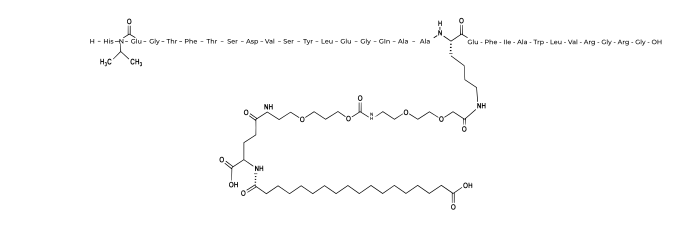
Pink beads = the two deliberate substitutions (one blocks the enzyme that destroys natural GLP-1 within minutes). Green bead = the lysine carrying the fatty-acid chain that anchors the peptide to albumin in the blood.
Where Semaglutide comes from
Your intestine already makes the original. GLP-1 is an incretin, a hormone released when food arrives, and it does several sensible things at once: it tells the pancreas to release insulin while glucose is high, tells the liver to stop pouring out extra sugar, slows the stomach, and tells the brain you have had enough. Researchers saw the therapeutic potential decades ago, but natural GLP-1 breaks down in minutes, which is useless for a medicine.
Semaglutide is the solution to that problem. Scientists at Novo Nordisk, building on an earlier daily compound called liraglutide, published the design in 2015: adjust two amino acids to resist breakdown, then attach a fatty-acid side chain so the peptide rides through the bloodstream bound to albumin, protected and slowly released. The result held its effect for about a week. It became Ozempic for diabetes in 2017, and the era of the GLP-1s began in earnest.
Lasts minutes
Resists breakdown, binds albumin
Lasts about a week
How Semaglutide works
Semaglutide activates GLP-1 receptors in several places at once, and each site contributes something different.


It prompts insulin release only when blood sugar is elevated, and it quiets glucagon, the hormone that tells the liver to release stored sugar. The glucose dependence is why it carries a low risk of driving blood sugar too low on its own. [1, 4]

.svg)
Food leaves the stomach more gradually, softening the blood sugar rise after meals and keeping you full longer. This is the mechanism Dr. Koniver points to first: fuller sooner, satisfied longer, eating less without feeling deprived. [1, 2]
.svg)
Semaglutide reaches GLP-1 receptors in the hypothalamus and in reward circuits, so food noise quiets and portions shrink without a constant act of willpower - less a test of discipline, more a changed relationship with food. [1, 2]
And one honest counterweight: about two-thirds of lost weight returns within a year of stopping without a plan [3].
What the research shows, and what it hasn't yet shown
This is the rare directory page where the human evidence is the strong suit, and we can simply report it.
In the pivotal obesity trial, STEP 1, 1,961 adults without diabetes received weekly semaglutide or placebo for 68 weeks alongside lifestyle support. The semaglutide group lost 14.9% of body weight on average, against 2.4% with placebo; 86.4% lost at least 5% of their weight, and half lost 15% or more. A Mayo Clinic real-world study found meaningful but somewhat smaller results in ordinary practice: 5.9% at three months and 10.9% at six months, a reminder that trial conditions are a best case.
The cardiovascular evidence is what set semaglutide apart from earlier weight medicines. In SELECT, 17,604 adults with heart disease and excess weight, but no diabetes, were followed for over three years: major cardiovascular events fell by 20% versus placebo. A follow-on analysis showed the weight loss held for up to four years. Earlier, the SUSTAIN-6 trial in type 2 diabetes had shown the first cardiovascular risk reduction, and the diabetes program showed meaningful long-term blood sugar improvement. More recent trials have extended the story to kidney protection in diabetes and to the liver disease MASH.
The research is just as clear about the uncomfortable part. In the STEP 1 extension, people who stopped semaglutide, and stopped the lifestyle support with it, regained about two-thirds of their lost weight within a year. That finding does not argue against the medicine; it argues against using it without a plan. It is the published version of what Dr. Koniver says about crutches, and it is why our use of semaglutide always points toward an exit.
STEP 1, 2021 [2]
1,961 adults without diabetes carrying excess weight
Placebo-controlled, double-blind, randomized, 68 weeks
14.9% average weight loss vs 2.4% placebo; 86.4% lost 5% or more
Trial conditions; 68 weeks
SELECT, 2023 (weight analysis 2024) [5,6]
17,604 adults with cardiovascular disease and excess weight
Long-term randomized, placebo-controlled outcomes trial
20% fewer major cardiovascular events; weight loss sustained up to 4 years
CV-disease population; modest average weight loss
STEP 1 extension, 2022 [3]
327 completers followed after stopping
One-year off-treatment follow-up
About two-thirds of lost weight regained
Exploratory subset
Real-world study, 2022 [7]
175 clinic patients (Mayo)
Retrospective cohort
5.9% loss at 3 months, 10.9% at 6 months
Single center, 6-month follow-up
The evidence, area by area
The strongest evidence base in this directory - and honest rows for the two open questions.
Semaglutide's side-effect profile is well mapped because so many people have taken it in trials. The common effects are digestive: nausea early on for many people, along with constipation, heartburn, or diarrhea, usually easing as the body adjusts. Dr. Koniver names these plainly, and they are the practical reason we start low and climb slowly; most of the misery people associate with these medicines comes from pushing the pace.
The serious items are rarer and specific. The US label carries a boxed warning based on thyroid C-cell tumors in rodents; whether that translates to humans is unknown, and anyone with a history, personal or in the family, of medullary thyroid cancer or MEN 2 should not take it. Pancreatitis and gallbladder problems, the latter more likely with rapid weight loss, are on the label, as is a rare bowel-motility problem called ileus.
In 2025, European regulators concluded that a rare optic-nerve condition called NAION is a very rare side effect, on the order of one in ten thousand users per year. Rapid weight loss can also take muscle with it, a real loss at midlife and beyond; our pace-and-protein approach exists because of it. Semaglutide is avoided in pregnancy and breastfeeding.
Where it comes from matters now.
The market changed in 2025: with compounded copies wound down, products sold outside licensed pharmacy channels are a genuine hazard. Counterfeit pens have been documented, and some compounded products used salt forms of semaglutide that were never the approved molecule. This medicine should come from a licensed pharmacy with a real prescription, full stop.
Regulatory status
Regulatory information current as of 13 August 2026.
This is a summary, not legal or medical advice, and status can change.

Ozempic approved - type 2 diabetes, weekly injection
Rybelsus approved - first oral GLP-1 tablet
Wegovy approved - chronic weight management
Heart indication - cardiovascular risk reduction
Kidneys and liver - kidney indication (Jan); MASH accelerated approval (Aug)
Oral weight-management form - first oral GLP-1 for weight
United States
APPROVED MEDICINE
A fully approved prescription medicine across multiple products and indications (see the timeline above). Obtained through standard prescription channels.
Compounded copies
ERA ENDED
Permitted only during the official shortage. Shortage resolved February 2025; copies wound down April-May 2025; in April 2026 the FDA moved to close the remaining bulk-compounding pathway. Narrow medical-need exceptions only.
Sport (WADA)
NOT PROHIBITED
GLP-1s are not banned in sport. WADA is monitoring their use by athletes, so competing athletes should keep an eye on future lists.
Everywhere else
A regulated prescription medicine essentially worldwide (EU approval includes the 2025 NAION labeling note). Products sold outside licensed channels carry the quality risks described in the safety section.
Semaglutide, answered plainly
Yes. It is a 31-amino-acid peptide, an engineered version of the natural gut hormone GLP-1. As Dr. Koniver puts it, the GLP-1 medicines are peptides; they are simply the ones that became famous[1]
They contain the same molecule. Ozempic and Wegovy are weekly injections approved for different purposes, and Rybelsus is a daily tablet; an oral weight-management version was added in late 2025. The regulatory section above lays out which product carries which approval.
Without a plan, mostly yes: in the trial that followed people after stopping, about two-thirds of lost weight returned within a year. That is why our approach treats semaglutide as a tool with an exit, with habits built during the loss and, for many patients, a peptide-supported off-ramp rather than an abrupt stop[3]
The rules changed in 2025 and the compounded-copy era has largely ended; see the regulatory status section above for the specifics and the dates.
Semaglutide activates the GLP-1 receptor; tirzepatide works on GLP-1 plus a second gut-hormone receptor. Both are weekly injectable peptides with strong trial results. In our practice we now use tirzepatide most, with semaglutide remaining the right choice for some patients; the deciding factors are individual response and tolerance.
Related in this directory


References
- Lau J, Bloch P, Schäffer L, et al. Discovery of the Once-Weekly Glucagon-Like Peptide-1 (GLP-1) Analogue Semaglutide. J Med Chem. 2015;58(18):7370-7380. PMID 26308095.
- Wilding JPH, Batterham RL, Calanna S, et al. Once-Weekly Semaglutide in Adults with Overweight or Obesity (STEP 1). N Engl J Med. 2021;384(11):989-1002. PMID 33567185.
- Wilding JPH, Batterham RL, Davies M, et al. Weight regain and cardiometabolic effects after withdrawal of semaglutide: The STEP 1 trial extension. Diabetes Obes Metab. 2022;24(8):1553-1564. PMID 35441470.
- Marso SP, Bain SC, Consoli A, et al. Semaglutide and Cardiovascular Outcomes in Patients with Type 2 Diabetes (SUSTAIN-6). N Engl J Med. 2016;375(19):1834-1844. PMID 27633186.
- Lincoff AM, Brown-Frandsen K, Colhoun HM, et al. Semaglutide and Cardiovascular Outcomes in Obesity without Diabetes (SELECT). N Engl J Med. 2023;389(24):2221-2232. PMID 37952131.
- Ryan DH, Lingvay I, Deanfield J, et al. Long-term weight loss effects of semaglutide in obesity without diabetes in the SELECT trial. Nat Med. 2024;30(7):2049-2057. PMID 38740993.
- Ghusn W, De la Rosa A, Sacoto D, et al. Weight Loss Outcomes Associated With Semaglutide Treatment for Patients With Overweight or Obesity. JAMA Netw Open. 2022;5(9):e2231982. PMID 36121652.
- Molecular data: semaglutide, PubChem CID 56843331, formula C187H291N45O59, molecular weight ~4113.6 g/mol. Regulatory sources: FDA (approvals and compounding guidance, updated June 2026), EMA PRAC (June 2025), USADA/WADA status pages (2026).
- Koniver C. The Koniver Method - clinical training for physicians, nurse practitioners and physician assistants (peptide modules). Statements attributed to Dr. Koniver and to the Koniver Wellness practice reflect clinical observation and teaching.
This page is for informational and educational purposes and does not constitute medical advice, diagnosis, or treatment. Semaglutide is a prescription medicine; whether it is appropriate for any individual is a decision for that person and their licensed clinician. Statements describing how Dr. Koniver and the Koniver Wellness team use GLP-1 medicines reflect clinical experience and judgment, which is not the same as controlled clinical evidence. Nothing here is a substitute for consultation with a qualified healthcare provider. Weight-management care at Koniver Wellness is provided under physician supervision after appropriate screening. Regulatory information on this page is provided for general awareness, is current as of the date shown, and may have changed; verify with official sources or a licensed practitioner in your jurisdiction before making any decision.
INTERESTED IN PEPTIDES?
START WITH THE RIGHT QUESTIONS.
Understand what peptides can and cannot do, what the evidence actually says, and whether physician-guided peptide therapy makes sense for you.