
AOD-9604
What We've Seen in Practice, and What the Research Says
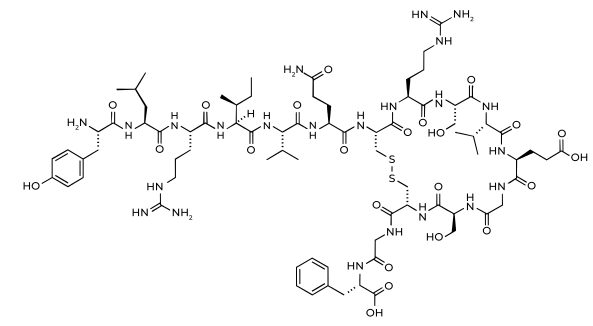
AOD-9604 is a lab-made peptide of sixteen amino acids, copied from the small region of human growth hormone associated with fat metabolism. It is unusual among wellness peptides for one reason: it went through a real clinical trial program, with six controlled human trials in more than 900 people, before its development as an obesity drug ended without approval. [1]
This page gives you both parts of the picture: what we have seen using AOD-9604 with patients at Koniver Wellness, and what those trials and the wider research actually showed. The two are labeled throughout, because they are different kinds of knowledge - and this peptide's story needs both told straight.

What we've seen in practice
At Koniver Wellness, AOD-9604 is not a peptide we use alone or first. It belongs to a combination Dr. Koniver teaches for body composition: AOD-9604 alongside tesamorelin and MOTS-c, three peptides that come at the same goal from different angles. [10]
Dr. Koniver is direct about where that combination stands. It is not as strong or as fast as a GLP-1 medication, and for weight loss our practice works predominantly with tirzepatide. What we have seen is that the combination earns its place in three situations: patients who are not ready for a GLP-1, patients who want an option beside it, and patients coming off a GLP-1 who want support holding their results while their habits carry the load. [10]
That last part is not a disclaimer. It is the mechanism, as Dr. Koniver teaches it: this combination showed itself in patients who paired it with clean eating, a lot of walking, and good sleep. The peptides support the work. They do not replace it. [10]
The specific observation that keeps AOD-9604 in the combination is abdominal fat. In Dr. Koniver's words, it surprisingly seems to work on belly fat: patients using AOD-9604, alone or in the combination, kept coming back reporting reduced fat around the abdomen. He is careful about what that is. As he puts it, that is just what we have observed with our patients. It is clinical observation, not a trial result, and the research section below tells you what the trials found. [10]
On tolerability, our experience matches the published record: side effects have been rare to absent. Dr. Koniver calls it very safe in his experience, and the trial program below is one of the reasons peptide-experienced physicians tend to agree. Screening still comes first in our clinic, as it does for every peptide: active cancer and pregnancy rule peptide therapy out before it begins. And as with every tool we use, peptides are episodic: improve, then reassess, pause, or stop. [1, 10]
The research behind these observations - including Dr. Koniver's clinical observations - follows below.
AOD-9604 at a glance

A synthetic peptide of 16 amino acids reproducing the fat-metabolism region of human growth hormone, amino acids 176 to 191, plus one added stabilizing amino acid [1, 4]
.svg)
Weight loss and body composition (its original drug program); fat metabolism; early joint and cartilage questions [1, 2, 3]
.svg)
Six randomized controlled human trials (900+ participants) with a consistently clean safety record; a modest reported effect in a 12-week study; no significant weight loss in the 24-week pivotal trial; animal mechanism data; one rabbit joint study [1, 2, 3]
.svg)
Oral and intravenous forms were tested in the trial program; injection is the common form in clinical practice [1]
.svg)
Formula C78H123N23O23S2 · weight 1,815.1 g/mol · 16 amino acids [4]

Used under physician supervision, episodically, in combination for body composition. See what we've seen in practice above, and the regulatory status below
The sixteen-amino-acid sequence, in order.
Where AOD-9604 comes from
Growth hormone does many things at once. It builds tissue, raises IGF-1, shifts glucose handling, and mobilizes fat. In the 1990s, researchers in Australia isolated the small piece of the molecule responsible for the last job: the tail region of growth hormone, amino acids 176 to 191. They reproduced it synthetically, added one amino acid to stabilize it, and named the result for its purpose: AOD stands for Anti-Obesity Drug.[1]
The idea was elegant. Keep growth hormone's fat-mobilizing signal, drop everything else. The company behind it, Metabolic Pharmaceuticals, took AOD-9604 through a full clinical program in the 2000s: six randomized, placebo-controlled trials, more than 900 participants, oral and intravenous forms. The safety results were consistently good. The weight-loss results were not good enough, and development ended in 2007. That honest arc, a clean safety record without a demonstrated weight-loss effect at trial doses, is the starting point for everything else on this page.[1]
How AOD-9604 works

.svg)
AOD-9604 reproduces only growth hormone's lipolytic region. In the human trials it did not raise IGF-1, the growth marker that full growth hormone elevates, and it did not disturb glucose tolerance or insulin sensitivity. That selectivity is the peptide's defining feature.[1]

.svg)
In animal and laboratory studies, AOD-9604 stimulates lipolysis, the breakdown of stored fat, and inhibits lipogenesis, the formation of new fat.[2]
.svg)
Studies in mice, including animals engineered without the beta-3 adrenergic receptor, show that receptor carries part of AOD-9604's fat-metabolism effect.[2]
In a rabbit osteoarthritis model, injections of AOD-9604 into the joint improved cartilage and function measures, alone and alongside hyaluronic acid. It is one animal study, and we treat it as exactly that.[3]
The published human program [1]
What the research shows, and what it hasn't yet shown
AOD-9604 sits in an unusual position for this directory: it has more controlled human data than almost any peptide people ask us about, and that data tells a two-sided story.
(From the research) The safety side is strong. Across the six trials, each randomized, double-blind, and placebo-controlled, side effects were comparable to placebo, no serious adverse events were attributed to the peptide, no participants developed antibodies against it, IGF-1 did not rise, and glucose handling was unaffected.[1]
Trial program 2001-2007
900+ across six trials
Randomized, double-blind, placebo-controlled; oral and IV forms
Side effects comparable to placebo; no serious adverse events attributed; no antibodies; no IGF-1 rise; no glucose disturbance
Efficacy results mixed across trials [1]
12-week efficacy study
~300 adults with obesity
Randomized, placebo-controlled
Average loss of ~2.6 kg vs 0.8 kg on placebo; modest but statistically significant
Modest effect size; single trial [1]
24-week pivotal trial
534 participants with obesity
Randomized, placebo-controlled
No statistically significant weight loss at any dose; development ended
Ended the obesity program [1]
(From our practice) The abdominal-fat pattern we describe above is clinical observation, not trial evidence. The joint application has one rabbit study and no human trials.[3, 10] Anyone presenting AOD-9604 as a demonstrated fat-loss therapy is reading the trials selectively; anyone dismissing it entirely is ignoring a genuinely clean safety record. Both halves are true at once.
The evidence, area by area
Everything on this page assumes physician supervision. Peptides in clinical practice are prescribed and monitored, not bought and guessed at.
The trial program gives AOD-9604 an unusually solid tolerability record, and our clinical experience matches it. The standing rules still apply. In our clinic, screening rules out active cancer, because any compound derived from growth hormone deserves that caution even when IGF-1 stays flat, and pregnancy or breastfeeding, where safety data does not exist. Uncontrolled diabetes or serious metabolic disease calls for an individual medical conversation before any peptide is considered. [1, 10]
Product quality is the other half of safety. AOD-9604 sold through unregulated channels carries the same risks as every gray-market peptide: no assurance of purity, identity, or sterility. Regulated sourcing under a prescriber's care is not optional.
Regulatory status around the world
This section describes status only. It is not legal or medical advice, and availability rules change. Verify anything that matters with official sources or a licensed practitioner where you live.
Regulatory information current as of 12 August 2026.

Listed in Category 2 of the FDA's bulk drug substances lists for compounding
The FDA's Pharmacy Compounding Advisory Committee votes against recommending AOD-9604 for the approved 503A compounding list
Nomination shown as withdrawn on the FDA's list page; procedural, not an approval
Unapproved; not among the six peptides the committee recommended in July 2026
Sources: FDA PCAC December 2024 materials; FDA bulk drug substances page; July 2026 vote reporting [5, 6, 7, 8]
As a medicine,
worldwide
Not an approved medicine anywhere. The obesity program ended in 2007 without approval, and no health authority has approved it since.[1]
In competitive sport
Prohibited
Named explicitly on the WADA Prohibited List under S2.2.3, growth hormone fragments: "e.g. AOD-9604 and hGH 176-191." At all times, worldwide. Not a gray area.[9]
Everywhere else,
in general
Prescription-medicine frameworks differ by country. A compound unapproved in your jurisdiction is generally not available through its regulated medical channels, and products offered outside those channels carry the quality risks described in the safety section above.
AOD-9604, answered plainly
From the research
A 12-week trial reported a modest effect, and the larger 24-week pivotal trial found no significant weight loss, so trial evidence does not support it as a weight-loss therapy on its own. [1]
From our practice
Within a combination, alongside real changes in eating, movement, and sleep, patients have reported meaningful body-composition changes, most consistently around the abdomen. We hold both statements at once. [10]
Its human safety record is unusually well characterized for a peptide: six controlled trials with side effects comparable to placebo, no antibody formation, no IGF-1 elevation, and no glucose disturbance. In our practice it has been very well tolerated. Product quality from unregulated sources remains a separate, real risk. [1, 10]
They are different tools. GLP-1 medications act on appetite and metabolic signaling and have large controlled trials demonstrating substantial weight loss; they are the stronger and faster tool, and our weight-loss practice works predominantly with tirzepatide. AOD-9604 is gentler, with a cleaner side-effect profile in its trials but without demonstrated weight-loss efficacy at trial doses. In our practice its role is support: before, beside, or after a GLP-1, never as a replacement. [1, 10]
No human trial has tested that specifically. In our practice, reduced abdominal fat is the most consistent patient report we hear with this peptide, and Dr. Koniver flags it as an observation that surprised him. Clinical observation, plainly labeled. [10]
One rabbit osteoarthritis study reported improved cartilage and function measures with intra-articular AOD-9604, alone and with hyaluronic acid. No human joint trials exist. Early animal research, nothing more yet. [3]
No. It is named explicitly on the WADA Prohibited List as a growth hormone fragment, prohibited at all times, worldwide. The regulatory status section above has the specifics. [9]
Related in this directory


References
- Stier H, Vos E, Kenley D. Safety and Tolerability of the Hexadecapeptide AOD9604 in Humans. Journal of Endocrinology and Metabolism. 2013.
- Heffernan M, et al. Studies of the lipolytic hGH C-terminal fragment AOD9604 in obese and beta-3-AR knockout mice (2001 research program, incl. Endocrinology 2001).
- Kwon DR, Park GY. Effect of Intra-articular Injection of AOD9604 with or without Hyaluronic Acid in Rabbit Osteoarthritis Model. Annals of Clinical and Laboratory Science. 2015;45(4):426.
- PubChem. AOD-9604 (CID 71300630): molecular formula and weight.
- US FDA. Pharmacy Compounding Advisory Committee meeting materials, 4 December 2024.
- Alliance for Natural Health. Reporting of the 4 December 2024 PCAC votes.
- US FDA. Certain Bulk Drug Substances for Use in Compounding that May Present Significant Safety Risks (page updated 22 April 2026).
- AJMC. FDA Panel Backs 6 Peptides for Compounding (July 2026 PCAC votes).
- WADA. The Prohibited List, category S2.2.3 (growth hormone fragments, e.g. AOD-9604 and hGH 176-191).
- Koniver C. The Koniver Method - clinical training for physicians, nurse practitioners and physician assistants (peptide modules). Statements attributed to Dr. Koniver and to the Koniver Wellness practice reflect clinical observation and teaching.
This page is for informational and educational purposes and does not constitute medical advice, diagnosis, or treatment. It is not a substitute for consultation with a qualified healthcare provider. Statements describing the clinical experience of Dr. Koniver and the Koniver Wellness team reflect observation in practice, not the results of controlled clinical trials. Regulatory information on this page is provided for general awareness, is current as of the date shown, and may have changed; verify with official sources or a licensed practitioner in your jurisdiction before making any decision. Koniver Wellness serves a worldwide readership: the availability and regulatory status of the therapies discussed vary by country and region, so please check the laws and regulations of your own jurisdiction and consult a licensed local practitioner before pursuing any therapy. Therapies described on this site are prescribed and supervised by licensed physicians for Koniver Wellness patients. Use of this site does not create a physician-patient relationship.
INTERESTED IN PEPTIDES?
START WITH THE RIGHT QUESTIONS.
Understand what peptides can and cannot do, what the evidence actually says, and whether physician-guided peptide therapy makes sense for you.