
GHK-Cu
What We've Seen in Practice, and What the Research Says
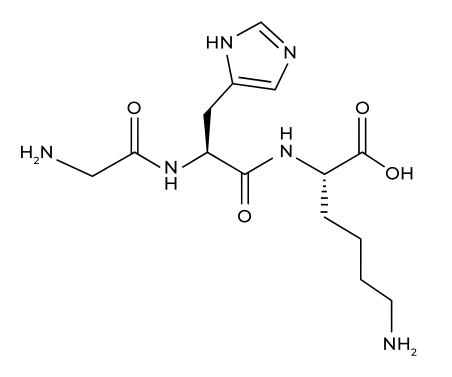
GHK-Cu is a copper peptide, and it is one of the more interesting molecules in this directory because your body already makes it. GHK is a tiny chain of three amino acids, and in the body it travels bound to a copper atom, which is where the "Cu" comes from and where its blue color comes from too. It turns up naturally in blood, and the amount you carry falls as you get older. That simple fact, a repair-and-renewal signal that fades with age, is a large part of why it has been studied so heavily.
Most of that study has focused on skin. GHK-Cu has been used in skincare for decades, and it has a real research record for wound healing, collagen, and tissue repair, alongside a large body of laboratory work on how it switches genes involved in repair and inflammation. It also has an honest limit, which we will be clear about: much of the deeper research is mechanistic or from small studies, and the large controlled human trials that would settle its therapeutic claims are limited.
One more thing shapes how we talk about GHK-Cu today. The injectable form was pulled from compounding in late 2023, but the topical form was not. So part of GHK-Cu stayed with us and part of it left, and that is where we will start.

What we've seen in practice
GHK-Cu was one of our all-time favorites, and Dr. Koniver does not say that about many peptides. It came up through the wound-healing world, where it was even used to help gums heal after dental work, and from there into aesthetic medicine, where practices reach for it to speed recovery after lasers and other skin procedures. We used it for all of that, and for more.
What Dr. Koniver valued most was not any single use but how broadly it healed. GHK-Cu calms inflammation and helps tissue repair, and on top of that it does two things most peptides do not. It supports DNA repair, which ties into the longevity side of our work, and it delivers copper. Copper is easy to overlook and hard to supplement well by mouth, yet the body needs it, both for the nervous system and for the mitochondria, where an enzyme that depends on copper helps run the machinery that makes cellular energy. In Dr. Koniver's view, GHK-Cu was one of the better ways to get copper where tissues could actually use it.
It also anchored one of our favorite intravenous treatments. Mixed with BPC-157 in saline and given slowly, the pair made a strong anti-inflammatory and healing drip that we especially liked after an injury or an aesthetic procedure. On its own it worked given under the skin, and as a topical cream. And it was part of the broader anti-inflammatory recovery approach we built around BPC-157, TB-500, GHK-copper, and KPV. Two practical notes patients remember: the copper gives the solution a blue tint, and it can sting a little going in, which is why we have people warm it first.
Then late 2023 changed what we could offer. The injectable form of GHK-Cu was placed in the FDA's Category 2, which closed the compounding route for injections and IVs. The topical form was not affected, so we did not lose GHK-Cu entirely the way we lost some others. We kept the topical, which is still a reasonable treatment, and we lost the more potent version, the injection and the IV, which is the one Dr. Koniver misses. As he puts it, we do not have that form anymore, but we wish we did.
Where it goes from here is genuinely open. GHK-Cu was not part of the group of peptides an FDA advisory committee recommended in mid-2026. It is instead set for its own review, expected by early 2027. We are watching that, and in the meantime the honest picture is the one above: topical still here, the injectable on hold, and a molecule we thought highly of waiting to see where the rules land.
The research behind these observations, including where it is strong and where it thins out, follows below.
GHK-Cu at a glance

A copper peptide: the natural three-amino-acid chain GHK (glycine-histidine-lysine) bound to a copper atom; the body makes it, and levels fall with age [1, 6]
.svg)
Skin rejuvenation and collagen, wound healing, tissue repair, hair, and general anti-inflammatory and antioxidant support[1,4]
.svg)
Decades of topical use, a large mechanistic and gene-expression research base, and small human topical studies; large controlled human trials are limited [1, 2,4]
.svg)
Topically (creams, widely available), and by injection or IV in the research and compounding literature
.svg)
The peptide GHK is C14H24N6O4 (340.38 g/mol); the copper complex (copper tripeptide-1) is about 402.9 g/mol; 3 amino acids plus copper[6]

Topical/cosmetic use is legal and widely available; the injectable form is in FDA Category 2 and set for a separate advisory-committee review by about February 2027; not specifically listed by WADA

One of our all-time favorites, used for skin and wound healing, DNA repair, and anti-inflammatory work, including a BPC-157 plus GHK-Cu IV; the injectable left our shelf in 2023, topical stayed. See what we've seen in practice above
Three amino acids (Gly-His-Lys) carrying a copper atom. The copper is coordinated by the histidine and the terminal amino group, and it is what gives the solution its blue color and much of its activity.
Where GHK-Cu comes from
Unlike most peptides in this directory, GHK-Cu is not a laboratory invention. The GHK peptide occurs naturally in the human body, where it was first identified in blood, and it does not travel alone: it binds a copper atom, forming the copper complex that carries its activity. That copper is the source of the peptide's signature blue color and a good deal of what it does.
The detail that launched decades of research is what happens to GHK with age. A young adult carries more of it than an older adult does, and that decline lines up with the slower wound healing and thinner skin that come with getting older. Researchers, most prominently Loren Pickart and Anna Margolina, proposed that GHK acts as one of the body's own repair signals, and that restoring it could nudge tissue back toward a more youthful, repair-ready state. That idea drove the skincare industry's long interest in it and the large research literature on how the peptide behaves in cells, and it is the frame most of the science below sits inside.
How GHK-Cu works

.svg)
Copper is a required cofactor for several important enzymes, including one that cross-links collagen and elastin, one that neutralizes damaging oxidants, and one deep in the mitochondria that helps produce cellular energy. GHK-Cu carries copper into tissue in a usable form, which is harder to accomplish with ordinary oral copper. [3,4]

.svg)
In skin cells, GHK-Cu prompts the production of collagen and other components of the supporting matrix, which is the basis for its long use in skin remodeling and wound repair. [1,4]
.svg)
Laboratory analysis by Pickart and Margolina found that GHK influences the activity of a wide range of genes tied to tissue repair, antioxidant defense, and inflammation, generally nudging them toward a repair pattern. It also lowers markers of oxidative stress in cell and animal models. These are mechanistic findings, and we present them as such.[1,2,3]
A strong mechanism and a long topical record; large controlled human trials remain limited[1,4]
What the research shows
Here is the whole picture, told plainly. GHK-Cu has more real-world history than almost anything else in this directory and a large research base, and at the same time its strongest human evidence is narrower than its reputation suggests.
(From the research) The deepest, most consistent work is mechanistic. A long series of studies, led largely by Pickart and Margolina, has mapped how GHK-Cu delivers copper, stimulates collagen and matrix repair, quiets oxidative stress, and modulates a broad panel of repair-related genes. On the human side, the strongest evidence is topical and cosmetic: small studies of GHK-Cu creams have reported improvements in skin firmness, texture, and appearance. Wound healing, hair, and the systemic or injectable uses rest more on cell and animal work than on large human trials.[1,2,3,4]
Now the limit, stated as plainly as the reputation. Much of the literature comes from a small number of dedicated researchers and is mechanistic or from small studies rather than large, independent, controlled human trials, and we have kept the animal and laboratory work clearly separated from the human work on this page, because the two are easily blurred. The honest description of GHK-Cu is "a natural repair peptide with a strong mechanism, a long topical track record, and thinner large-trial evidence for its bigger therapeutic claims." That is still a genuinely interesting profile. It is just not the same as settled proof for every use it gets marketed for.
Skin (topical)
Small human topical studies + mechanism
Improved firmness, texture, appearance; collagen stimulation
Small studies; cosmetic endpoints [1,4]
Mechanism / gene modulation
Extensive lab work (Pickart, Margolina)
Copper delivery, matrix repair, antioxidant and broad gene modulation
Mechanistic; single-group-dominated[1,2,3]
Wound healing
Cell and animal models
Faster closure, angiogenesis, tissue repair
Mostly preclinical; limited large human trials[4]
Hair and systemic
Mostly preclinical
Follicle and repair signals
Animal/mechanistic; human trials needed
The evidence, area by area
The green chip marks areas where our own clinical use informs the picture; it is experience, not trial data.
GHK-Cu has a long safety record in topical use, where decades of cosmetic and dermatology experience show it is generally well tolerated. The most important cautions are about the copper it carries rather than the peptide itself. Anyone with a copper-handling disorder should avoid it: that means Wilson's disease and other copper-metabolism conditions, and iron-and-copper overload conditions such as hemochromatosis. A small number of people react to copper with a rash or itching, and GHK-Cu can interact with copper-chelating medicines. As with any peptide, pregnancy and breastfeeding are exclusions for anything beyond ordinary cosmetic topical use.
The injectable form deserves its own note. It has far less long-term human safety data than the topical, and the specific reason it was restricted was concern about the purity and immune reactivity of compounded injectable product, not a signal from the peptide itself. That distinction matters now, because with the regulated injectable channel constrained, injectable GHK-Cu sold outside it comes from research-chemical suppliers of uncertain quality, which is a real and separate hazard. Topical product quality varies too, with a wide range of concentrations and accuracy across the market.
Regulatory status
The following is descriptive, not advice.
Regulatory status changes; the date below is when we last checked, and GHK-Cu is a moving target right now.
GHK-Cu's status depends on the route. The two forms are on different tracks.
Even a favorable February 2027 review would require formal rulemaking before injectable access changed. Topical cosmetic GHK-Cu remains broadly available internationally; injectable and therapeutic status varies by country.
Regulatory information current as of 12 August 2026.
TOPICAL/ COSMETIC
Available
Legal and widely sold in low-concentration creams and serums; a separate track from injectable drugs. This route was not removed.
Injectable (United States)
Under review
In FDA Category 2 since late 2023 (over immune-reactivity and purity of compounded injectable product). Not among the peptides recommended in July 2026; set for a separate advisory-committee review by about the end of February 2027. Interim status is unsettled; confirm the current position before acting.
IN COMPETITIVE SPORT
Not specifically listed
GHK-Cu is not specifically named on the WADA Prohibited List, and topical use is generally treated as permitted. The list is revised each January; verify before use.[8]
GHK-Cu, answered plainly
It is a copper peptide: the natural three-amino-acid chain GHK (glycine, histidine, lysine) bound to a copper atom. The body makes it, levels fall with age, and it has been studied mainly for skin, wound healing, and tissue repair, with a large body of work on how it delivers copper and shifts repair-related genes.
The topical skin evidence is its strongest human evidence.
FROM THE RESEARCH
Small studies of GHK-Cu creams have reported better firmness, texture, and appearance, consistent with its collagen-stimulating mechanism. It is genuinely useful topically; just note the studies are small, and the bigger therapeutic claims rest more on mechanism than on large trials.[1]
Because the injectable form was placed in FDA Category 2 in late 2023, which closed the compounding route we used for injections and IVs. That was a regulatory change, not a change in how well it worked for us. The topical form was not restricted, so we still have that. Dr. Koniver misses the injectable and IV version, which was the more potent one.
Topically it has a long, reassuring safety record. The main cautions are about copper: it should be avoided in Wilson's disease, hemochromatosis, and other copper-overload or copper-metabolism disorders, and a few people are sensitive to copper. Injectable product carries the added, separate risk of uncertain quality when sourced outside regulated channels.
It is not specifically listed by WADA, and topical use is generally treated as permitted, but that list changes annually. Any competitor should verify the current status first. The regulatory section above has the detail.[8]
Related in this directory


References
- Pickart L, Margolina A. GHK peptide as a natural modulator of multiple cellular pathways in skin regeneration. BioMed Research International. 2015;2015:648108. PMID 26236730.
- Pickart L, Margolina A. The effect of the human peptide GHK on gene expression relevant to nervous system function and cognitive decline. Brain Sciences. 2017;7(2):20. PMID 28212278. (Gene-expression analysis.)
- Pickart L, Vasquez-Soltero JM, Margolina A. The human tripeptide GHK-Cu in prevention of oxidative stress and degenerative conditions of aging. Oxidative Medicine and Cellular Longevity. 2012;2012:324832. PMID 22666519.
- Pickart L. The human tri-peptide GHK and tissue remodeling. Journal of Biomaterials Science, Polymer Edition. 2008;19(8):969-988. PMID 18644225.
- Miller DM, et al. Effects of glycyl-histidyl-lysyl chelated Cu(II) on ferritin dependent lipid peroxidation. Advances in Experimental Medicine and Biology. 1990;264:79-84. PMID 2244543.
- PubChem. GHK (CID 73587): C14H24N6O4, 340.38 g/mol; GHK-Cu / copper tripeptide-1 / prezatide copper (CID 71587328): copper complex, about 402.9 g/mol, CAS 89030-95-5.
- US FDA. 503A compounding review: injectable GHK-Cu Category 2 (2023); not among the July 2026 recommended peptides; separate review scheduled by about the end of February 2027. Topical/cosmetic on a separate track. (Injectable status in transition.)
- World Anti-Doping Agency. The Prohibited List (GHK-Cu not specifically listed; reviewed annually).
- Koniver C. The Koniver Method - clinical training for physicians, nurse practitioners and physician assistants (peptide modules). Statements attributed to Dr. Koniver and to the Koniver Wellness practice reflect clinical observation and teaching.
This page is for informational and educational purposes and does not constitute medical advice, diagnosis, or treatment. It is not a substitute for consultation with a qualified healthcare provider. GHK-Cu is not approved by the FDA as a therapeutic drug; its topical cosmetic use and its injectable/compounding status are regulated differently, and the injectable status is under review. Statements describing how Dr. Koniver and the Koniver Wellness team have used and view GHK-Cu reflect clinical experience and judgment, which is not the same as controlled clinical evidence. Regulatory information on this page is provided for general awareness, is current as of the date shown, and may have changed; verify with official sources or a licensed practitioner in your jurisdiction before making any decision. Koniver Wellness serves a worldwide readership: the availability and regulatory status of the therapies discussed vary by country and region, so please check the laws and regulations of your own jurisdiction and consult a licensed local practitioner before pursuing any therapy. Availability of any given peptide or route depends on its regulatory and supply status. Therapies described on this site are prescribed and supervised by licensed physicians for Koniver Wellness patients. Use of this site does not create a physician-patient relationship.
INTERESTED IN PEPTIDES?
START WITH THE RIGHT QUESTIONS.
Understand what peptides can and cannot do, what the evidence actually says, and whether physician-guided peptide therapy makes sense for you.