
BPC-157
What We've Seen in Practice, and What the Research Says
BPC-157 is one of the most talked-about peptides in the world. It is a lab-made chain of fifteen amino acids, based on a fragment of a protective protein found in human gastric juice. Most of the research behind it comes from animal studies, where it has been examined for tendon and soft-tissue repair, protection of the gut lining, and inflammation. [1, 6, 7]
This page gives you both parts of the picture: what we have seen using BPC-157 with patients at Koniver Wellness, and what the published research shows and has not yet shown. The two are labeled throughout, because they are different kinds of knowledge - and you need both.

What we've seen in practice
Dr. Craig Koniver, who has used peptides with patients for more than a decade and now also trains other physicians in this work, considers BPC-157 the most versatile peptide we have worked with. For years it was the one we used most. Asked to sum it up, his answer is short: very anti-inflammatory [14]
We used it with physically active patients protecting or repairing soft tissue, with people recovering from surgery or illness, for digestive complaints, and for inflammation that would not settle on its own. [14]
The tendon pattern explains why athletes found it first. Most training injuries do not happen in the muscle. Muscle strengthens quickly; the tendons and ligaments anchoring it adapt slowly, so problems concentrate at those attachment points - strains, tendinitis, sometimes a rupture. In our experience, BPC-157 was protective of exactly that tissue, and athletes at every level - weekend exercisers through professionals - used it with us for that reason. It is also how Dr. Koniver came to peptides in the first place: caring for competitive athletes who wanted to recover well without harsher compounds. [14]
Two more things we learned over the years. BPC-157 increases the number of growth hormone receptors on healing tissue, so we often paired it with peptides that prompt the body's own growth hormone release - one raises the signal, the other helps the tissue receive it. That matches Dr. Koniver's view of peptides in general: signals the body already understands, useful because they make the body's own signaling more efficient, not because they force anything. And on forms: injectable worked better than oral in our experience, with one exception - the gut lining, the tissue this molecule comes from, is where the oral form makes sense. [14]
On side effects: they were rare. Across years of use, BPC-157 was among the best-tolerated tools in our practice, and that record is the first reason Dr. Koniver trusts peptides as a category. He is also clear about what kind of evidence this is. Formal clinical trials are scarce for most peptides. His confidence comes from the physiological data and from long, careful observation of patients, not from trial results. Screening still came first: we ruled out active cancer and pregnancy before starting any patient on a peptide. [14]
Response was not instant. The pattern we saw with BPC-157 was improvement building over the first few weeks, then continuing: less inflammation, less pain, better function. We also used peptides episodically, the way Dr. Koniver teaches them: improve, then reassess, pause, or stop. They are not lifetime commitments. [14]
In recent years our clinical work moved from BPC-157 to pentadeca arginate (PDA), and the reason was regulatory, not clinical. In late 2023, BPC-157 was placed on the FDA's Category 2 compounding list, and the regulated pharmacies we source from could no longer prepare it. We did not lose confidence in BPC-157. We lost the supply channel we trust. PDA has the same fifteen-amino-acid backbone with one amino acid exchanged, and Dr. Koniver calls it "the new BPC". It has since earned its place on its own results. The clearest difference we have seen is speed: BPC-157 typically showed itself over a couple of weeks, while patients on PDA kept reporting change within days - foot, ankle, and knee complaints easing within the first few injections. These are clinical reports, not trial results, and the published research still belongs almost entirely to BPC-157. Dr. Koniver's position on PDA is plain: no reservations, very safe in his experience, very happy with it. [14]
That regulatory picture is now moving again, in a direction we are glad to see. BPC-157 came off the Category 2 list in April 2026, and in July 2026 the FDA's compounding advisory committee voted to recommend adding it to the approved compounding list. The final decision is still ahead; the regulatory status section below has the details. Our position is simple. BPC-157 is a peptide we know well and used with confidence for years, and we welcome every step that brings it back within reach of regulated, physician-supervised care. [11, 15, 16]
The research behind these observations - including Dr. Koniver's clinical observations - follows below.
BPC-157 at a glance

A synthetic peptide of 15 amino acids (a "pentadecapeptide") reproducing a fragment of a protective protein in human gastric juice [6, 7]
.svg)
Tendon, ligament, muscle, and bone healing; gut-lining protection; inflammation; blood-vessel repair [1, 4, 7, 8]
.svg)
Extensive, consistent animal research (35 of 36 studies in the leading 2025 review); two small uncontrolled human studies; one registered human trial with no published results [1, 3, 9, 13]
.svg)
Injection in most research; an oral route explored mainly for gut-focused questions, because the molecule resists digestion unusually well [7, 8]
.svg)
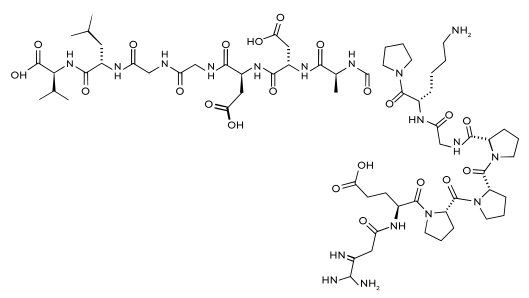
Formula C62H98N16O22 · weight 1,419.5 g/mol · 15 amino acids [10]

Used under physician supervision, episodically, with screening first. See what we've seen in practice above, and the regulatory status below
The fifteen-amino-acid sequence, in order.
Where BPC-157 comes from
BPC stands for Body Protection Compound, a protective protein that researchers identified in human gastric juice. BPC-157 is the stable, active fragment of that protein, made synthetically: fifteen amino acids that hold together even in stomach acid.[6, 7]
Because it came from the stomach, researchers studied the stomach first. In early pharmaceutical development it was investigated as a possible therapy for inflammatory bowel disease, under research names like PL-10 and PL 14736. Then animal studies kept finding effects outside the gut: in tendon, ligament, muscle, and bone. That range is a large part of why so many people have heard of it today.[1, 4, 7]
How BPC-157 works
Research points to several overlapping mechanisms. They share one theme: BPC-157 appears to support repair processes the body already runs, rather than adding a foreign one.

.svg)
Tendons have poor circulation, and healing depends on blood supply. BPC-157 activates VEGFR2, a key receptor in the growth of new blood vessels, and researchers describe it opening alternative routes around damaged circulation. [2, 8]

.svg)
In laboratory studies, tendon cells exposed to BPC-157 grew outward faster, survived longer, and moved more readily. These are the cell behaviors that rebuild damaged tissue. [5]
.svg)
BPC-157 increases the number of growth hormone receptors on tendon cells, so the growth hormone already in circulation has more effect. This is the research finding behind the pairing approach we described above. [6]
.svg)
In animal models, treated tissue shows lower levels of inflammatory cytokines, the messenger molecules that keep swelling and pain going. The wider literature also describes effects on nitric-oxide pathways that support blood-vessel function. [1, 2, 7, 8]
2025 systematic review, HSS Journal [1]
What the research shows, and what it hasn't yet shown
The animal evidence is broad and consistent. A 2025 systematic review in orthopaedic sports medicine screened 544 articles published since 1993 and included 36 studies. Thirty-five were preclinical. Across muscle, tendon, ligament, and bone models, the review reports improved functional, structural, and biomechanical outcomes. [1] The most cited single experiment is an early one: in rats with surgically cut Achilles tendons, BPC-157 sped up healing. [4] The gut research is just as steady, with protective effects on the stomach and intestinal lining across many animal models. [7, 8]
Knee pain case series 2021
16 patients surveyed (17 enrolled)
Retrospective chart review with telephone follow-up
14 of 16 reported relief; 11 of the 12 who received BPC-157 alone improved; 7 of those 12 described relief lasting more than six months
No control group; no standardized outcome measures [3, 1]
Bladder pain pilot 2024
12 women
Open-label, single clinic, single treatment during cystoscopy
10 of 12 complete symptom resolution, 2 partial; no adverse events reported
No control group; patient-reported; run by the treating clinicians [9]
Phase 1 safety study registered 2015
42 healthy volunteers (planned)
Randomized, placebo-controlled, oral tablets
No results ever posted; registry record never updated after December 2015
Status unknown; nothing published [13]
The published record: no adverse events were documented in the two small human studies, and animal safety work reports no toxicity across several organ systems. At the same time, the 2025 review states plainly that no clinical safety data were found. [1]
In our practice, BPC-157 sat among the best-tolerated tools we used (see above).[14] Both statements are true. They are different kinds of evidence, and we label them so you always know which you are reading.
What requires caution. The available studies are graded as lower-level evidence, and reviewers call for controlled trials.[1] One theoretical question follows from the mechanism itself: a molecule that promotes blood-vessel growth deserves caution around cancer. No direct evidence of carcinogenesis has appeared in the available studies, but reviews advise care in anyone with an active malignancy or a history of cancer. [2] There is also a practical hazard: products sold through unregulated channels carry real risks of contamination, impurity, and mislabeling. [1]
The evidence, area by area
Everything on this page assumes physician supervision. In clinical practice, peptides are prescribed and monitored. They are not bought and guessed at.
Screening comes before any peptide. In our clinic that has always meant ruling out active cancer (see the caution above) and pregnancy or breastfeeding, where safety data does not exist.[2, 14] A personal history of cancer calls for an individual medical conversation rather than a general rule.
Product quality is the other half of safety. Material sold as "research grade" comes with no assurance of purity, identity, or sterility, and the review literature warns about this directly.[1] Sourcing through regulated pharmacies, under a prescriber's care, is what separates a known molecule from an unknown one.
Regulatory status around the world
This section describes status only. It is not legal or medical advice, and availability rules change.
Verify anything that matters with official sources or a licensed practitioner where you live.
Regulatory information current as of 11 August 2026.

Placed on the FDA's Category 2 compounding list, the category for substances that may present significant safety risks
Off that list: the nomination shown as withdrawn by the original nominators. A procedural change, not an approval
The FDA's Pharmacy Compounding Advisory Committee votes to recommend adding BPC-157 to the approved 503A compounding list
FDA decision pending. Rulemaking is still ahead; BPC-157 remains unapproved
Sources: FDA bulk drug substances page; FDA PCAC meeting, July 2026; press reporting of the votes [11, 15, 16]
As a medicine,
worldwide
Not an approved medicine anywhere: no national health authority, the US FDA included, has authorized BPC-157 for human therapeutic use.[12]
In competitive sport
Prohibited
WADA Prohibited List, category S0, at all times, in and out of competition, worldwide. USADA names BPC-157 explicitly (advisory updated 10 August 2026).[12]
Everywhere else,
in general
Prescription-medicine frameworks differ by country. A compound unapproved in your jurisdiction is generally not available through its regulated medical channels, and products offered outside those channels carry the quality risks described in the safety section above.
BPC-157, answered plainly
FROM THE RESEARCH
In animal research, consistently: dozens of models across three decades show faster and structurally better healing of tendon and ligament injuries. In humans it has not been properly tested. One small uncontrolled knee study is the entire published record.[1, 3, 4, 5]
FROM OUR PRACTICE
Soft-tissue support was the main thing we used it for, and what we saw matched the animal pattern.[14]
The molecule comes from the stomach's own protective chemistry, and animal studies consistently show protective effects on the gut lining. Human trial data has not been published. The oral route makes most sense here, because BPC-157 survives digestion. Our experience pointed the same way.[7, 8, 14]
Two answers, labeled.
FROM THE RESEARCH
No adverse events in two small human studies and reassuring animal data, but no systematic human safety research.[1, 2, 3, 9]
FROM OUR PRACTICE
It was among the best-tolerated tools we used.[14] Product quality from unregulated sources is a separate, real risk either way.[1]
Pentadeca arginate (PDA) shares BPC-157's fifteen-amino-acid backbone with one amino acid exchanged. The published research belongs to BPC-157; PDA's profile rests on that shared structure and on clinical experience. Our practice now works with PDA. Dr. Koniver calls it "the new BPC," and we have seen a faster onset, with patients reporting change within days.[14]
No. It is prohibited for tested athletes at all times, worldwide. The regulatory status section above has the specifics.[12]
Research has not established a human timeline. The one knee study assessed patients months after treatment.[3] As clinical observation only: in our practice, improvement typically built over the first few weeks with BPC-157, and patient reports came faster with its successor PDA.[14] Be careful with confident timelines online. Until controlled trials exist, nobody can give you one.

References
- Vasireddi N, et al. Emerging Use of BPC-157 in Orthopaedic Sports Medicine: A Systematic Review. HSS Journal. 2025;21(4):485-495.
- Cushman DM, et al. Regeneration or Risk? A Narrative Review of BPC-157 for Musculoskeletal Healing. Current Reviews in Musculoskeletal Medicine. 2025;18(12):611-619.
- Lee E, Padgett B. Intra-Articular Injection of BPC 157 for Multiple Types of Knee Pain. Alternative Therapies in Health and Medicine. 2021;27(4):8-13.
- Staresinic M, et al. Gastric pentadecapeptide BPC 157 accelerates healing of transected rat Achilles tendon. Journal of Orthopaedic Research. 2003;21(6):976-983.
- Chang CH, et al. The promoting effect of pentadecapeptide BPC 157 on tendon healing involves tendon outgrowth, cell survival, and cell migration. Journal of Applied Physiology. 2011;110(3):774-780.
- Chang CH, et al. Pentadecapeptide BPC 157 Enhances the Growth Hormone Receptor Expression in Tendon Fibroblasts. Molecules. 2014;19(11):19066-19077.
- Sikiric P, et al. Stable gastric pentadecapeptide BPC 157 in trials for inflammatory bowel disease. Current Pharmaceutical Design. 2006.
- Sikiric P, et al. Stable Gastric Pentadecapeptide BPC 157: Prompt Particular Activation of Collateral Pathways. Current Medicinal Chemistry. 2023;30(13).
- Lee E, Walker C, Ayadi B. Effect of BPC-157 on Symptoms in Patients with Interstitial Cystitis: A Pilot Study. Alternative Therapies in Health and Medicine. 2024.
- PubChem. BPC-157 (CID 9941957): molecular formula and weight.
- US FDA. Certain Bulk Drug Substances for Use in Compounding that May Present Significant Safety Risks (page updated 22 April 2026).
- US Anti-Doping Agency. BPC-157: Experimental Peptide Creates Risk for Athletes (updated 10 August 2026); WADA Prohibited List, S0.
- ClinicalTrials.gov. PCO-02 - Safety and Pharmacokinetics Trial (NCT02637284).
- Koniver C. The Koniver Method - clinical training for physicians, nurse practitioners and physician assistants (peptide modules). Statements attributed to Dr. Koniver and to the Koniver Wellness practice reflect clinical observation and teaching.
- US FDA. Pharmacy Compounding Advisory Committee, meeting of 23-24 July 2026.
- AJMC. FDA Panel Backs 6 Peptides for Compounding (report of the July 2026 PCAC votes).
This page is for informational and educational purposes and does not constitute medical advice, diagnosis, or treatment. It is not a substitute for consultation with a qualified healthcare provider. Statements describing the clinical experience of Dr. Koniver and the Koniver Wellness team reflect observation in practice, not the results of controlled clinical trials. Regulatory information on this page is provided for general awareness, is current as of the date shown, and may have changed; verify with official sources or a licensed practitioner in your jurisdiction before making any decision. Koniver Wellness serves a worldwide readership: the availability and regulatory status of the therapies discussed vary by country and region, so please check the laws and regulations of your own jurisdiction and consult a licensed local practitioner before pursuing any therapy. Therapies described on this site are prescribed and supervised by licensed physicians for Koniver Wellness patients. Use of this site does not create a physician-patient relationship.
INTERESTED IN PEPTIDES?
START WITH THE RIGHT QUESTIONS.
Understand what peptides can and cannot do, what the evidence actually says, and whether physician-guided peptide therapy makes sense for you.