
LL-37
The Body's Own Antimicrobial Peptide
LL-37 is the single antimicrobial peptide of its kind that the human body makes for itself. It is a 37-amino-acid piece cut from a larger protein held inside white blood cells and skin, and it does two jobs at once: it breaks apart the membranes of bacteria, fungi, and enveloped viruses, and it calls immune cells to the site.
We use it on the immune side of our practice, where its job is different from the peptides that steady or rebalance an immune system.

What we have seen in practice
LL-37 is the aggressive one. Dr. Koniver's way of putting it is that LL-37 wages war on pathogens: where our other immune peptides work by lifting an immune response that is falling behind or settling one that is running too hot, LL-37 goes directly after the invaders themselves, the bacteria and the virus particles. That difference is why it sits in a different place in our thinking. It is not the peptide we reach for to rebalance an immune system. It is the peptide we reach for when there is something to clear.
We give it as a subcutaneous injection, and a nasal spray, and Dr. Koniver prefers the evening for it. In his experience it is very well tolerated, and he has not seen it cause problems in patients. We use it alongside the other immune peptides in our practice rather than on its own.
LL-37 at a glance

A 37-amino-acid host-defence peptide the human body makes, released from a stored precursor protein in white blood cells and skin
.svg)
Cathelicidin; ropocamptide; originally described as FALL-39
.svg)
Direct antimicrobial activity against bacteria, fungi, and enveloped viruses; endotoxin neutralisation; immune cell recruitment; wound healing
.svg)
Deep and well-established human biology; one randomised human trial, which was topical and in wounds; the only completed trial of injected LL-37 enrolled four patients
.svg)
Subcutaneous injection and nasal spray in wellness practice; the human trial evidence is topical
.svg)
37 amino acids, formula C205H340N60O53, about 4,493 g/mol, strongly positively charged, no sulfur

Not FDA-approved; nominated for the compounding list and then withdrawn from nomination, with an FDA advisory committee review scheduled for early 2027; not named by WADA. Details below

Our pathogen-directed immune peptide, distinct from the ones that modulate
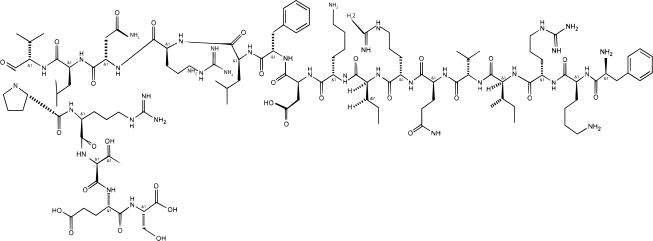
Sequence, 37 residues
Pink beads: the two leading leucines the name refers to. Lime beads: the eleven positively charged residues (six lysine, five arginine) that pull the peptide onto negatively charged bacterial membranes. No sulfur beads - LL-37 contains neither cysteine nor methionine.
The name is a description
LL-37 begins with two leucine residues and is 37 residues long, and that is the whole of it. Its sequence is fixed and known, it carries no sulfur because it contains neither of the two sulfur-bearing amino acids, and its striking feature is charge: it holds eleven strongly positive residues against five negative ones. That positive charge is not a footnote. It is the reason the peptide finds bacterial membranes, which carry a negative surface charge that human cell membranes largely do not.
Where LL-37 comes from
Humans carry exactly one cathelicidin. Other mammals carry several; we have this one, produced from a single gene, which makes LL-37 unusually central to how the body handles microbes at its own surfaces.
It is not stored in an active state. Neutrophils, the first white blood cells to arrive at an infection, hold it as a larger, inert precursor protein inside their granules; skin, airway, and gut lining cells make it too. When those cells are activated, an enzyme cuts the precursor and releases the working 37-residue peptide right where it is needed. It was first reported in 1995 by two groups at once, one describing the precursor in neutrophils and the other describing the peptide itself, which they named for the four amino acids it started with before the predominant shorter form was pinned down. [1,2]
There is one more thread in the origin story that turns out to matter. The gene that makes LL-37 is switched on by vitamin D. Researchers established in 2004 and 2005 that the gene is a direct target of the vitamin D receptor, and in 2006 a study in Science showed the sequence end to end in human immune cells: an immune receptor detects a bacterial signal, the cell responds by increasing its vitamin D machinery, that machinery switches on the LL-37 gene, and the resulting peptide helps the cell kill the bacterium. It is one of the clearest accounts anywhere of how vitamin D status connects to real immune function.[4,5,6]
Bacterial signal detected
Immune receptor activates
Vitamin D machinery increases
CAMP gene switches on
LL-37 released, bacterium killed
Shown end to end in human immune cells (Science, 2006) [6]
How LL-37 works


In water LL-37 is a loose strand, but on contact with a membrane it folds into a helix with its water-loving side facing one way and its fat-loving side the other. Its strong positive charge draws it to the negatively charged outer surface of bacterial membranes, and the helix inserts and disrupts them. Because the target is the membrane itself rather than a single enzyme, this is a difficult mechanism for a microbe to engineer its way around.[3]

.svg)
When gram-negative bacteria break apart they release lipopolysaccharide, the molecule responsible for much of the damage in severe infection. LL-37 binds it and neutralises it, which means the peptide can reduce the inflammatory consequences of an infection at the same time as it reduces the infection.[3]
.svg)
Beyond killing microbes directly, LL-37 acts as a signal. It attracts neutrophils, monocytes, and T-cells toward the site, influences how dendritic cells behave, and in doing so links the fast, general innate response to the slower, specific one.[3]
.svg)
The same peptide supports the regrowth of surface tissue and the formation of new small blood vessels. This is the mechanism the one randomised human trial set out to test.[3, 7]
Bacterial membrane, negatively charged at the surface. Approach, landing, insertion. The dashed lime segment is the breach.
The evidence, in four numbers
Well-understood biology, narrow treatment evidence. The two are not the same thing.
What the research shows
The biology of LL-37 in humans is not in question. It is a well-characterised human peptide with thousands of published studies behind it, a known gene, a known precursor, a known structure, and a mechanism worked out in detail. What is far thinner is the evidence for giving LL-37 to people as a treatment, and those two things are easy to confuse.
The strongest treatment evidence is a randomised, placebo-controlled trial in wound healing, and it was topical. Thirty-four people with hard-to-heal venous leg ulcers went through a three-week placebo run-in and then four weeks of double-blind treatment with LL-37 applied to the wound twice weekly at one of three concentrations, or placebo. At the two lower concentrations, healing ran roughly six times and three times faster than placebo by the trial's healing-rate measure, and mean ulcer area fell by 68 percent and 50 percent. Reported tolerability was good, with no local or systemic safety concerns. The highest concentration did no better than placebo, so more was not better, which is a useful signal about how this peptide behaves. [7]
Injected LL-37 in humans is a much shorter story. The only completed interventional trial we could find gave LL-37 by injection directly into melanoma tumours, at a single US cancer centre, and it enrolled four patients before completing in 2020. That is the extent of it. [10]
There is also a large human literature that measures the body's own LL-37 rather than administering any, tracking it against vitamin D status, infection, smoking exposure, and skin and oral disease. It is genuine human data and it tells us the peptide matters. It does not tell us what happens when LL-37 is injected for immune support, because that is not what it studied.
LL-37 is one of the best-understood peptides in human immunology and one of the least-tested as an injected therapy. Our use of it rests on that biology together with clinical experience.
Wound healing, applied topically
One randomised placebo-controlled trial, 34 participants
Faster healing at lower concentrations; no benefit at the highest
Human trial evidence
Antimicrobial activity
Extensive laboratory and animal work
Membrane-disrupting activity against bacteria, fungi, enveloped viruses
Laboratory and animal
Endotoxin neutralisation and immune signalling
Laboratory and animal work
Binds endotoxin; recruits immune cells
Laboratory and animal
Vitamin D and immune function
Human cell and tissue studies
The gene is a direct vitamin D target; the pathway is mapped in human immune cells
Established human biology
Injected LL-37 as a therapy
One completed trial, four patients, in melanoma
Too small to draw conclusions from
No meaningful trial evidence
Immune support in our patients
Clinical experience
Well tolerated; used where there are pathogens to clear
Clinical observation (our practice)
Where each claim stands
LL-37 has a more complicated safety picture than most of the peptides in this directory, and the complication comes from the peptide's own biology rather than from toxicity in the ordinary sense.
Start with what is directly observed. In the topical wound trial there were no local or systemic safety concerns at any concentration tested. Dr. Koniver's own experience with subcutaneous LL-37 is that it is very well tolerated, and he has not seen a patient run into trouble with it. Injection-site reactions are the ordinary expectation with any injected peptide.
LL-37 is an inflammatory signal as well as an antimicrobial one. In rosacea, skin shows elevated cathelicidin together with increased protease activity that processes it, and that combination promotes the inflammation of the condition. In psoriasis, LL-37 released into inflamed skin can bind the patient's own DNA and, in that complex, trigger an interferon response from immune cells that would normally ignore self-DNA. Anyone with an inflammatory skin condition or an autoimmune history should raise LL-37 specifically with their physician. [8,9]
The FDA has published its own concerns. In the agency's assessment, compounded drugs containing LL-37 may pose a risk of immunogenicity for certain routes of administration and may involve complexities around peptide-related impurities and characterisation of the active ingredient; the agency states that it lacks sufficient safety information to know whether the drug would cause harm when administered to humans; and it notes nonclinical research findings suggesting detrimental effects on male reproduction and that the substance can be protumorigenic in some tissues. Those are preclinical findings and an agency's statement of uncertainty rather than observations in patients, but they are on the record and they belong on this page. They are part of why LL-37 belongs under physician supervision after screening, and why we avoid it in pregnancy and breastfeeding.[12]
Because LL-37 reaches the wellness market entirely through research and compounding channels, sourcing and product quality matter as much here as anywhere in this directory, and the FDA's characterisation point is a reminder that peptide purity is not a given.
Regulatory status

Nominated as a bulk substance for compounding
Put forward for the list of substances compounding pharmacies may use.
Withdrawn from nomination; concerns published
Now on the FDA's nominated-but-withdrawn record, with the agency's concerns stated. Records updated 22 April 2026.
Advisory committee review scheduled
The FDA has announced a meeting before the end of February 2027 to consider five substances, LL-37 among them.
As a medicine, worldwide
NOT APPROVED
Not an approved medicine in any jurisdiction we could verify. It holds the international nonproprietary name ropocamptide, which reflects pharmaceutical development activity rather than any approval.
United States
UNDER ACTIVE REVIEW
Not FDA-approved for any use. Nominated as a compounding bulk substance, then withdrawn from nomination, with the agency's concerns published. An advisory committee will consider it before the end of February 2027.
Sport (WADA)
NOT NAMED ON THE LIST
LL-37 is not named on the current Prohibited List. Because it is not an approved medicine, the List's catch-all category for non-approved substances may still apply in tested sport. Confirm with your governing body.
Everywhere else
VARIES BY COUNTRY
Prescription-medicine frameworks differ by country; a compound unapproved in a reader's jurisdiction is generally not available through regulated medical channels there, and products sold outside those channels carry the quality risks described in the safety section.
Regulatory information current as of 13 August 2026. This is a summary, not legal advice, and status can change.
LL-37, answered plainly
It is the only antimicrobial peptide of its kind that the human body makes: a 37-amino-acid peptide released from a stored precursor in white blood cells and in the lining of skin, airway, and gut. It kills microbes by breaking their membranes and also signals other immune cells to respond.
It works on the invader rather than on the immune system. Dr. Koniver describes LL-37 as waging war on pathogens, going after bacteria and virus particles directly, where a modulating peptide raises an immune response that is underperforming or settles one that is overactive. They address different problems.
A direct one. The gene that produces LL-37 is switched on by the vitamin D receptor, and research in human immune cells has mapped the full sequence: a cell detects a bacterial signal, ramps up its vitamin D machinery, switches on the LL-37 gene, and uses the resulting peptide to kill the bacterium. It is one of the clearest mechanistic links between vitamin D status and immune function.
No. It is not approved in the United States or, as far as we can verify, anywhere else, and it reaches the wellness market through research and compounding channels. Its US compounding status is under active review with an advisory committee meeting scheduled for early 2027. The regulatory section above has the detail.
Yes, but narrowly. One randomised placebo-controlled trial in 34 people tested it applied topically to hard-to-heal leg ulcers and found faster healing at the lower concentrations. The only completed trial of injected LL-37 enrolled four melanoma patients. There is no trial of injected LL-37 for general immune support.
Related in this directory


References
- Agerberth B, Gunne H, Odeberg J, et al. FALL-39, a putative human peptide antibiotic, is cysteine-free and expressed in bone marrow and testis. Proc Natl Acad Sci USA. 1995;92(1):195-199. PMID 7529412.
- Cowland JB, Johnsen AH, Borregaard N. hCAP-18, a cathelin/pro-bactenecin-like protein of human neutrophil specific granules. FEBS Lett. 1995;368(1):173-176. PMID 7615076.
- Durr UH, Sudheendra US, Ramamoorthy A. LL-37, the only human member of the cathelicidin family of antimicrobial peptides. Biochim Biophys Acta. 2006;1758(9):1408-1425. PMID 16716248.
- Wang TT, Nestel FP, Bourdeau V, et al. Cutting edge: 1,25-dihydroxyvitamin D3 is a direct inducer of antimicrobial peptide gene expression. J Immunol. 2004;173(5):2909-2912. PMID 15322146.
- Gombart AF, Borregaard N, Koeffler HP. Human cathelicidin antimicrobial peptide (CAMP) gene is a direct target of the vitamin D receptor and is strongly up-regulated in myeloid cells by 1,25-dihydroxyvitamin D3. FASEB J. 2005;19(9):1067-1077. PMID 15985530.
- Liu PT, Stenger S, Li H, et al. Toll-like receptor triggering of a vitamin D-mediated human antimicrobial response. Science. 2006;311(5768):1770-1773. PMID 16497887.
- Gronberg A, Mahlapuu M, Stahle M, Whately-Smith C, Rollman O. Treatment with LL-37 is safe and effective in enhancing healing of hard-to-heal venous leg ulcers: a randomized, placebo-controlled clinical trial. Wound Repair Regen. 2014;22(5):613-621. PMID 25041740.
- Yamasaki K, Di Nardo A, Bardan A, et al. Increased serine protease activity and cathelicidin promotes skin inflammation in rosacea. Nat Med. 2007;13(8):975-980. PMID 17676051.
- Lande R, Gregorio J, Facchinetti V, et al. Plasmacytoid dendritic cells sense self-DNA coupled with antimicrobial peptide. Nature. 2007;449(7162):564-569. PMID 17873860.
- ClinicalTrials.gov identifier NCT02225366. Induction of Antitumor Response in Melanoma Patients Using the Antimicrobial Peptide LL37. Phase 1/2, 4 participants, completed November 2020.
- Molecular data: LL-37 (cathelicidin, ropocamptide), PubChem CID 16198951, formula C205H340N60O53, molecular weight approximately 4,493 g/mol; sequence LLGDFFRKSKEKIGKEFKRIVQRIKDFLRNLVPRTES.
- Regulatory sources: US Food and Drug Administration, Certain Bulk Drug Substances for Use in Compounding that May Present Significant Safety Risks (updated 22 April 2026); US Food and Drug Administration, Meeting of the Pharmacy Compounding Advisory Committee (meeting announced to be held before the end of February 2027).
- Koniver C. The Koniver Method - clinical training for physicians, nurse practitioners and physician assistants (peptide modules). Statements attributed to Dr. Koniver and to the Koniver Wellness practice reflect clinical observation and teaching.
This page is for informational and educational purposes and does not constitute medical advice, diagnosis, or treatment. LL-37 is not approved by the FDA for any use in the United States and is available only through research and compounding channels; its status is under active regulatory review. Statements describing how Dr. Koniver and the Koniver Wellness team use LL-37 reflect clinical experience and judgment, which is not the same as controlled clinical evidence. Nothing here is a substitute for consultation with a qualified healthcare provider. Peptide therapy at Koniver Wellness is provided under physician supervision after appropriate screening, and the availability of any given peptide depends on its regulatory and supply status. Regulatory information is current as of the date shown and may have changed; verify with official sources or a licensed practitioner in your jurisdiction.
INTERESTED IN PEPTIDES?
START WITH THE RIGHT QUESTIONS.
Understand what peptides can and cannot do, what the evidence actually says, and whether physician-guided peptide therapy makes sense for you.