
Epitalon
What We've Seen in Practice, and What the Research Says
Epitalon is a very small peptide, just four amino acids, modeled on a substance the pineal gland in your brain makes on its own. It arrives with one of the biggest reputations in the longevity world: it is the "telomere peptide," the one people reach for when they want to slow aging at the level of the chromosome. That reputation is not made up, but it is not the whole story either, and the gap between the two is exactly where an honest page earns its keep.
Here is how we hold it. There is real laboratory science behind Epitalon, a long research history, and a genuine human signal, mostly around sleep and circadian rhythm. There is not a large modern trial telling us which patients benefit, at what dose, over what period, or with what long-term risk. And there is a specific safety question that comes with the telomere mechanism itself. We walk through all of it below.

What we've seen in practice
We will start with the honest headline, because Dr. Koniver leads with it himself: he does not chase telomere lengthening. When people talk about Epitalon, telomeres are almost always the first thing they raise, and Dr. Koniver's response is to slow down. As he puts it, he does not get caught up in the telomere story, because the cause and effect is genuinely unclear. Are longer telomeres the reason someone lives longer, or are they simply a marker of a body that is aging well for other reasons? Nobody can say for certain. So we do not sell Epitalon as a way to lengthen your telomeres, and if that is the only reason someone wants it, we tend to talk them out of it.
What Dr. Koniver has valued Epitalon for is something quieter and, in our experience, more reliable: circadian rhythm. Used at a low dose at bedtime, it became one of our most versatile tools for helping a body that had lost its natural day-night rhythm find it again. Modern life is hard on the circadian clock, artificial light late into the evening, screens, irregular schedules, and that lost rhythm feeds into a great deal of how tired, unsettled, and unrecovered people feel. Epitalon, in Dr. Koniver's hands, was a way to help reset that rhythm and support the adrenals, alongside its antioxidant effects. We used it most often as part of a sleep-focused combination, paired with pinealon and selank, to help people reach deeper, more restorative sleep.
We are writing about this partly in the past tense, and we want to be open about why. In the fall of 2023 the FDA moved Epitalon onto its Category 2 restricted tier, which stopped licensed compounding pharmacies from preparing it. We did not stop using Epitalon because it stopped working. We lost access to a regulated supply of a peptide we valued. Dr. Koniver has been plain about it: he wishes it were still available, and we would be using it readily if it were. So this is genuinely good news, and we will say so directly: in July 2026 the FDA's advisory committee on compounding recommended Epitalon as one of six peptides for the approved compounding list. That is not the same as it being available again tomorrow, the FDA still has to act on the recommendation, but it is real movement in the right direction, and we are watching it closely.
The one screen that matters most. As with everything we use, screening comes first, and for Epitalon one screen matters more than usual. Because its most-studied mechanism touches telomerase, the same enzyme most cancers rely on to keep dividing, we do not use it in anyone with active, prior, or suspected cancer, and we are careful about family history. That caution is built into how the practice works and it is not negotiable.
The research behind these observations, including Dr. Koniver's clinical observations, follows below.
Epitalon at a glance

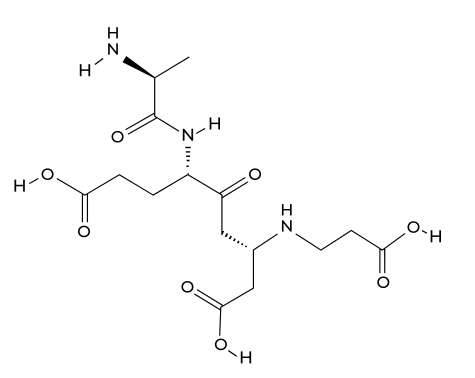
A synthetic peptide of four amino acids (Ala-Glu-Asp-Gly), modeled on a natural pineal-gland peptide [4]
.svg)
Longevity and cellular aging (mostly in the laboratory and in animals); sleep and circadian rhythm; retinal protection [1, 2, 3]
.svg)
Decades of preclinical work (telomerase, melatonin, lifespan in animals) plus two small human trials reporting benefit and no serious adverse events; most research from a single group; no modern large trial [1, 2, 3]
.svg)
Subcutaneous injection, in cycles rather than continuously
.svg)
Formula C14H22N4O9 · weight 390.35 g/mol · 4 amino acids [4]
Its proposed telomerase mechanism overlaps with cancer biology; active, prior, or suspected cancer rules it out

We used it mainly as a low-dose circadian-rhythm and sleep tool; access was lost to a 2023 FDA restriction, with favorable movement in 2026. See what we've seen in practice above, and the regulatory status below
The four-amino-acid sequence, in order. One of the smallest peptides in the directory.
Where Epitalon comes from
Deep in your brain sits the pineal gland, a structure the size of a grain of rice that helps run your body's clock, most famously by releasing melatonin as darkness falls. In the 1970s, researchers in what was then the Soviet Union, led by Vladimir Khavinson at the St. Petersburg Institute of Bioregulation and Gerontology, extracted a peptide preparation from the pineal gland and called it epithalamin. They spent decades studying it as a "bioregulator," a signal that might help an aging body keep its systems in tune.
Epitalon is the synthetic, simplified descendant of that work: a four-amino-acid peptide made to capture the active idea of the pineal extract in a single defined molecule. That lineage matters for reading the evidence. Much of the most striking human data, including a long follow-up study reporting lower disease and mortality rates in elderly patients, involved the original pineal extract, often given alongside a second peptide, in Russian research cohorts. That is a different thing from the synthetic tetrapeptide given on its own, and we keep the two straight rather than letting the extract's reputation stand in for the peptide's own evidence.
How Epitalon works

.svg)
Epitalon is modeled on a pineal peptide, and the pineal gland governs melatonin and circadian rhythm. In aged animals it restored melatonin output and shifted the genes that keep the internal clock on time. This is the mechanism closest to what we actually used it for.[1]

.svg)
In cultured human cells, Epitalon switches on telomerase, the enzyme that rebuilds telomeres, the protective caps on chromosomes that shorten as cells divide. Treated cells have shown telomere lengthening and extended division capacity. It is real, and it is a cell-culture finding. What it means for a whole living person over years is exactly what has not been established.[2, 3]
.svg)
In preclinical work, Epitalon affects oxidative-stress and antioxidant pathways and shifts the activity of genes tied to cellular aging. Lifespan was extended in mice, rats, and fruit flies across multiple animal studies from the originating program.[1]
Decades of preclinical work, a thin human record, mostly from one institution [1, 2, 3]
What the research shows
The fair summary of Epitalon's evidence is that it is long on volume and short on rigor, and both halves of that sentence are true.
The preclinical record is genuinely substantial. Across more than two decades, Epitalon activated telomerase in human cells, lengthened telomeres in the lab, restored melatonin in aged animals, and extended lifespan in several animal species. The direction of the findings is consistent. On the human side there are two small trials, one in patients with the degenerative eye disease retinitis pigmentosa, one in older women looking at sleep and circadian rhythm. Both reported benefit and neither reported serious adverse events.[1, 2, 3]Now the other half, stated just as plainly. The great majority of this research comes from a single institution, and independent replication outside that group is limited. Neither human trial was built to modern first-in-human safety standards. There have been no formal genotoxicity, carcinogenicity, or drug-interaction studies, and there is no human data at all on lifespan or biological age, the very outcomes the peptide is famous for. So the accurate way to describe Epitalon is not as a demonstrated anti-aging therapy and not as snake oil, but as a compound with a real mechanism, a real preclinical record, a real but thin human signal, and a real gap where the confirming trials should be. We would rather tell you that than sell you past it.
Telomerase and telomeres
Cell-culture studies in human cells
Telomerase activated; telomeres lengthened; division capacity extended
Laboratory only; single originating group [2, 3]
Lifespan
Animal studies (mice, rats, fruit flies)
Lifespan extended across species
Animal models; no human lifespan data [1]
Longevity in people
Long follow-up in elderly cohorts
Lower disease and mortality reported
Used the pineal extract, often with a second peptide, not the tetrapeptide alone; single-group Russian cohorts [1]
Sleep and circadian
One small human trial (older women)
Measurable circadian improvement; no serious adverse events
Small; single group; not a modern safety trial
Retina
One small human trial (retinitis pigmentosa)
Measurable visual benefit; no serious adverse events
Small; single group; limited replication
The evidence, area by area
In the two small human trials, Epitalon was well tolerated and no serious adverse events were reported, and across animal studies it has not shown liver or kidney toxicity. Several mouse studies even reported fewer tumors, which is a reassuring preclinical signal. Taken together, the short-term picture is calm.[1]
The caution we will not soften. Epitalon's headline mechanism is telomerase activation, and telomerase is the same enzyme most cancers switch on to keep multiplying. No one has done the human safety studies in people with cancer, because those are exactly the people you would never enroll. The honest implication is simple: a compound that turns on telomerase deserves real caution, and it is absolutely not appropriate for anyone with active, previously treated, or suspected cancer, or a family history that raises that concern. This is the first thing we screen for, along with pregnancy, and it is a firm line, not a soft one.
The other limits are the ones any careful reader should keep in view: no long-term repeated-dose human safety data, no formal genotoxicity or drug-interaction studies, and, for anything bought outside a regulated channel, no assurance of what the product actually contains. A peptide that acts on fundamental cell-division machinery is the last one you want to self-prescribe from an unverified source.
Regulatory status
The following is descriptive, not advice. Regulatory status changes; the date below is when we last checked.
Regulatory information current as of 12 August 2026.

The FDA places Epitalon on the Category 2 restricted tier; licensed compounding pharmacies can no longer prepare it
Nomination shown as withdrawn on the FDA's list; the Category 2 prohibition is lifted
The FDA's Pharmacy Compounding Advisory Committee recommends Epitalon as one of six peptides for the approved 503A compounding list (advisory)
Unapproved, but off Category 2 and carrying a positive July 2026 recommendation; FDA rulemaking pending
Sources: FDA bulk drug substances page; July 2026 PCAC meeting; vote reporting [6, 7]
As a medicine,
worldwide
Not an approved medicine anywhere. A long research history in Russia and the former Soviet Union, but no modern regulatory approval.[1]
In competitive sport
Not currently listed
Epitalon is not named on the WADA Prohibited List. WADA updates its list yearly, so verify current status with your sport's governing body before considering it.[8]
Everywhere else,
in general
No national health authority has approved Epitalon for general medical use. Availability and rules vary by country, and status can change.
Epitalon, answered plainly
It is a synthetic peptide of four amino acids, modeled on a natural peptide from the pineal gland, the part of the brain that helps run your sleep and circadian rhythm. It is best known as a "longevity" or "telomere" peptide, though most of that evidence is from the laboratory and from animals.
From the research
It activates telomerase and lengthens telomeres in cell-culture studies, and it extends lifespan in animals. What has never been shown is that this produces longer or healthier life in people, because those trials do not exist.[2, 3]
From our practice
Dr. Koniver deliberately does not lead with the telomere claim, because whether longer telomeres cause longer life or simply reflect it is genuinely unresolved. We think that honesty matters here.
(From our practice) Mainly circadian rhythm and sleep. Used at a low dose at bedtime, it helped reset a day-night rhythm knocked out of alignment by modern life, and we often paired it with pinealon and selank in a sleep-focused combination. We valued it as one of our more versatile tools before access was restricted.
In the small human trials it was well tolerated with no serious adverse events, and animal studies have not shown organ toxicity. The one caution we hold above all others is that its telomerase mechanism overlaps with cancer biology, so it is not appropriate for anyone with active, prior, or suspected cancer, and we screen for that first. There is also no long-term human safety data, which is a real limit.
The FDA restricted it under Category 2 in the fall of 2023, which stopped compounding pharmacies from making it. In 2026 that restriction was lifted and an FDA advisory committee recommended it for the approved compounding list. The FDA has not finalized that yet, so availability is still uncertain, but the movement has been favorable and we are watching it.
It is not currently named on the WADA Prohibited List, but that list changes yearly, so verify current status with your sport's governing body before considering it.[8]
Related in this directory


References
- Khavinson VKh, Morozov VG. Peptides of pineal gland and thymus prolong human life. Neuro Endocrinology Letters. 2003;24(3-4):233-240. (Elderly cohort, Thymalin plus pineal extract.)
- Khavinson VKh, et al. Epithalon peptide induces telomerase activity and telomere elongation in human somatic cells. Bulletin of Experimental Biology and Medicine. 2003.
- Khavinson VKh, et al. Peptide promotes overcoming of the division limit in human somatic cells. Bulletin of Experimental Biology and Medicine. 2004.
- PubChem. Epitalon / Epithalon (CID 219042): molecular formula and weight.
- Pineal peptide effect on the diurnal profile of arterial pressure in middle-aged and elderly women. Advances in Gerontology. 2008.
- US FDA. Pharmacy Compounding Advisory Committee, 23-24 July 2026 meeting (Epitalon among the six peptides recommended for the 503A bulks list); FDA bulk drug substances list page (Category 2 September 2023; withdrawn 22 April 2026).
- AJMC. FDA Panel Backs 6 Peptides for Compounding (report of the July 2026 PCAC recommendations).
- WADA. The Prohibited List (Epitalon not currently named).
- Koniver C. The Koniver Method - clinical training for physicians, nurse practitioners and physician assistants (peptide modules). Statements attributed to Dr. Koniver and to the Koniver Wellness practice reflect clinical observation and teaching.
This page is for informational and educational purposes and does not constitute medical advice, diagnosis, or treatment. It is not a substitute for consultation with a qualified healthcare provider. Epitalon is not approved by the FDA or any national health authority for therapeutic use. Because its proposed mechanism involves telomerase, which is also active in most cancers, it is not appropriate for anyone with active, previously treated, or suspected malignancy. Statements describing the clinical experience of Dr. Koniver and the Koniver Wellness team reflect observation in practice, not the results of controlled clinical trials. Regulatory information on this page is provided for general awareness, is current as of the date shown, and may have changed; verify with official sources or a licensed practitioner in your jurisdiction before making any decision. Koniver Wellness serves a worldwide readership: the availability and regulatory status of the therapies discussed vary by country and region, so please check the laws and regulations of your own jurisdiction and consult a licensed local practitioner before pursuing any therapy. Therapies described on this site are prescribed and supervised by licensed physicians for Koniver Wellness patients. Use of this site does not create a physician-patient relationship.
INTERESTED IN PEPTIDES?
START WITH THE RIGHT QUESTIONS.
Understand what peptides can and cannot do, what the evidence actually says, and whether physician-guided peptide therapy makes sense for you.