
ARA-290
What We've Seen in Practice, and What the Research Says
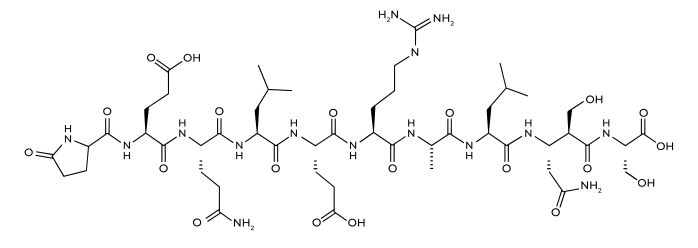
ARA-290 is one of the quieter peptides in this directory, and one of the more interesting. It is a lab-made chain of eleven amino acids, copied from one face of erythropoietin, the hormone the body uses to make red blood cells. The copy keeps the part of that hormone that protects and repairs tissue and leaves out the part that raises red cell count. So it carries erythropoietin's healing signal without thickening the blood.
Most people have never heard of it. The research on it is small but real, and it points in one clear direction: the repair of small nerves. That is also where we reach for it in practice.

What we've seen in practice
At Koniver Wellness, ARA-290 is a peptide we use mostly for nerve-related problems. When a patient has pain, numbness, tingling, or burning that traces back to small-nerve irritation, whether the cause is metabolic, nutritional, or diabetic, ARA-290 is one of the tools Dr. Koniver considers. It is not a peptide we use for everyone, and it is not a first move for general recovery. Its lane is the nervous system.
One case Dr. Koniver teaches from stayed with us. A patient came in still struggling months after a foot surgery. The bone had healed, but she felt as though a nerve in the area had been disrupted and had never settled. We started her on ARA-290, and within a few weeks she said she felt substantially better. That is one patient, and one patient is not a study, so we hold it lightly. But it fit the pattern we look for: a small nerve that will not calm down on its own, and a peptide whose whole design is to help nerves recover.
In our hands it has been very well tolerated. Dr. Koniver's plain read is that ARA-290 is a safe, still-underused peptide with a specific job, and that most of the excitement around it belongs to nerve issues, inflammation, and the nervous system rather than to broad "anti-aging" claims. We are still learning where else it earns a place, and we keep that learning honest: where the evidence is thin, we say so, on this page and in the room.
We rarely use it alone. ARA-290 pairs naturally with our repair and anti-inflammatory peptides, and Dr. Koniver often combines it with pentadeca arginate and thymalin so that a healing plan comes at the problem from more than one angle. As with every peptide here, we screen first, we use it in courses rather than indefinitely, and we reassess rather than assume.
The research behind these observations, including Dr. Koniver's clinical observations, follows below.
ARA-290 at a glance

A synthetic peptide of 11 amino acids (international name cibinetide) copied from the tissue-protective face of erythropoietin; it does not raise red blood cell count [4, 9]
.svg)
Small-fiber neuropathy (sarcoidosis and diabetic); nerve-fiber regeneration; inflammation and tissue protection [3, 4, 5]
.svg)
Three small controlled human trials; the clean, significant signal is nerve-fiber regeneration; pain scores often improved on placebo too; a consistently good safety record; no approved use anywhere [3, 4, 5]
.svg)
Studied by subcutaneous and intravenous injection; injection is the form used in clinical practice [3, 4]
.svg)
Formula C51H84N16O21 · weight 1,257.3 g/mol · 11 amino acids [9]

Used under physician supervision, in courses, mainly for nerve-related problems, often in combination. See what we've seen in practice above, and the regulatory status below
The eleven-amino-acid sequence, in order. The first bead (Pyr) is a pyroglutamate cap on the N-terminus.
Where ARA-290 comes from
Erythropoietin, or EPO, is best known as the hormone that tells the bone marrow to make red blood cells. That is the reputation that follows it into sport, where injected EPO is a banned blood-booster. But EPO has a second life inside the body: at sites of injury it acts as a local protect-and-repair signal for tissue, and that side of it has nothing to do with red blood cells.
Researchers led by the scientists who first mapped this second role set out to separate the two. They found that the protective signal lives on one helix of the erythropoietin molecule, and they built a short peptide, eleven amino acids long, that reproduces just that surface. The result was ARA-290, later given the name cibinetide. It switches on the repair side of erythropoietin's biology while leaving the blood-count side untouched. That is the whole idea, and it is why ARA-290 can be studied for nerve and tissue repair without the cardiovascular concerns that come with raising someone's red cell mass.
How ARA-290 works

.svg)
Tissue protection runs through the innate repair receptor, built from the erythropoietin receptor paired with a unit called CD131. ARA-290 was designed to fit that receptor specifically, which is why it can protect tissue without pushing red cell count. [1, 2]

.svg)
Through that same receptor, ARA-290 dials down the inflammatory signaling that keeps irritated tissue from settling, and shifts cells toward repair, in laboratory and animal work. [1, 2]
.svg)
The most striking human finding is not about pain scores but about the nerves themselves: in trials, ARA-290 was associated with the regrowth of small nerve fibers, measured in the cornea and skin, a direct sign of nerves repairing. [3, 5]
.svg)
Part of protecting a nerve is protecting its blood supply. ARA-290 has been studied for its effect on small-vessel circulation and the lining of blood vessels, which fits its use in neuropathies where microcirculation is part of the problem. [1, 2]
The published human program in sarcoidosis and diabetic neuropathy, 2012-2017 [3, 4, 5]
What the research shows
ARA-290 is unusual among the peptides in this directory: it has a genuine controlled human trial program, run by its developer with academic partners. The program is small, the trials are short, and it never reached an approved late-stage study. Here is what it actually found.
(From the research) The clearest, most repeatable result is nerve-fiber regeneration. In a Phase 2b trial in sarcoidosis patients with small-nerve-fiber loss, ARA-290 significantly increased the area of nerve fibers in the cornea and increased regenerating fibers in the skin, which the authors read as a sign of the disease process being modified rather than masked. An earlier pilot in sarcoidosis and a Phase 2 study in type 2 diabetes pointed the same way. [3,4,5]
The honest complication is pain. In more than one trial, pain improved in the people taking ARA-290, but it also improved in the people taking placebo, and the gap between the two was not always statistically meaningful. The fair summary: ARA-290 has shown it can help small nerves regenerate, and it has a clean safety record, while its effect on pain specifically is less clearly separated from placebo. Both halves are true at once. [3,5]
Sarcoidosis pilot 2012
22 patients with sarcoidosis and small-fiber neuropathy
Randomized, double-blind, placebo-controlled; intravenous, 4 weeks
Neuropathy screening score improved significantly vs placebo; pain and fatigue inventories improved equally in both groups
Very small; short; pain not separated from placebo [3]
Type 2 diabetes 2015
Adults with type 2 diabetes and neuropathic symptoms
Randomized, placebo-controlled; subcutaneous, 28 days plus follow-up
Neuropathic symptom score, blood-sugar (HbA1c), and lipids improved; nerve-fiber density rose in the worse-affected subset
Small; short; not an approved use [4]
Sarcoidosis Phase 2b 2017
64 patients with sarcoid small-nerve-fiber loss and pain
Randomized, placebo-controlled, dose-ranging; 28 days
Corneal nerve fiber area increased significantly; regenerating skin fibers increased; pain improved but not significantly vs placebo
Surrogate endpoints; pain not significant vs placebo [5]
The evidence, area by area
Tiers used across this directory
Across those three trials, ARA-290 was well tolerated. No serious adverse events were attributed to it, and, consistent with its design, it did not raise hematocrit or produce the cardiovascular signal that comes with red-cell-boosting drugs. That clean record is one of the genuinely attractive things about this peptide.[3,4,5]
The honest caveat is size. These were small studies over weeks, not large studies over years, so long-term safety in wide use is simply not yet mapped. As a molecule that protects and repairs tissue, it also carries a sensible theoretical caution around active cancer, which is why our screening rules out active malignancy and pregnancy before we consider it, as it does for every peptide here.
There is also a supply issue worth stating plainly. Because ARA-290 is not an approved medicine, most of what is sold online is unregulated "research chemical" material of unknown purity. That is a real hazard independent of the peptide itself, and it is one of the reasons we work only through physician-directed, quality-controlled channels.
Regulatory status
The following is descriptive, not advice. Regulatory status changes; the date below is when we last checked.
Regulatory information current as of 12 August 2026.

FDA grants ARA-290 orphan drug designation for sarcoidosis, a research incentive, not an approval
Unapproved investigational drug everywhere; not a compounding-list peptide; not among the six peptides the committee recommended in July 2026
Sources: FDA orphan drug designation record; PCAC July 2026 vote reporting [6, 7]
As a medicine,
worldwide
Not an approved medicine anywhere. An investigational compound; its trials reached Phase 2 and Phase 2b with no approved late-stage program. [3, 4, 5]
In competitive sport
Prohibited
Under WADA S0, non-approved substances, at all times. Note: it does not raise red blood cells, so it is prohibited for being unapproved, not for building blood. [8]
Everywhere else,
in general
No national health authority has approved ARA-290 for general medical use. Availability and rules vary by country, and products offered outside regulated channels carry the quality risks described in the safety section above.
ARA-290, answered plainly
It is a small synthetic peptide, eleven amino acids long, also called cibinetide. It copies the tissue-protective part of erythropoietin, the hormone that makes red blood cells, while leaving out the blood-making part. It is studied mainly for the repair of small nerves.
From the research: the research is genuinely mixed on pain specifically. Small trials showed that ARA-290 can help small nerve fibers regenerate, a real and measurable effect, but in those same trials pain often improved on placebo too, so the pain benefit was not always clearly separated from placebo.
From our practice: we have used it for nerve-related problems with patients who did well, though clinical observation is not the same as controlled proof, and we present it that way. [3, 5]
In the trials done so far it has been well tolerated, with no serious adverse events and, unlike injected erythropoietin, no rise in red blood cells or related cardiovascular strain. The important limits are that the studies were small and short, and that unregulated "research chemical" supply is a separate risk we avoid by working only through quality-controlled channels. [3, 4, 5]
Erythropoietin does two things: it tells the body to make red blood cells, and, separately, it protects and repairs tissue. ARA-290 was built to do only the second. That is why it can be studied for nerve and tissue repair without the blood-thickening and cardiovascular risks that make EPO itself a banned substance in sport.
From our practice: mainly for nerve-related problems, small-nerve irritation with pain, numbness, or tingling, where its whole design fits the goal. Dr. Koniver considers it a very safe, underused peptide with a specific lane, and often pairs it with pentadeca arginate and thymalin in a healing plan. We screen first and use it in courses.
No. It is prohibited at all times as a non-approved substance. The regulatory status section above has the specifics. [8]
Related in this directory


References
- Brines M, Cerami A, et al. Non-erythropoietic, tissue-protective peptides derived from erythropoietin (helix B surface peptide; ARA 290) and the innate repair receptor. Program papers.
- Brines M, et al. The nonerythropoietic tissue-protective peptide ARA 290 and the erythropoietin / CD131 innate repair receptor. Review and mechanism literature.
- Heij L, et al. Safety and efficacy of ARA 290 in sarcoidosis patients with symptoms of small fiber neuropathy: a randomized, double-blind pilot study. Molecular Medicine. 2012;18(1):1430-1436.
- Brines M, et al. ARA 290, a nonerythropoietic peptide engineered from erythropoietin, improves metabolic control and neuropathic symptoms in patients with type 2 diabetes. Molecular Medicine. 2015;20(1):658-666.
- Culver DA, et al. Cibinetide improves corneal nerve fiber abundance in patients with sarcoidosis-associated small nerve fiber loss and neuropathic pain. Investigative Ophthalmology & Visual Science. 2017;58(6):BIO52-BIO60.
- Araim Pharmaceuticals. FDA orphan drug designation for ARA 290 in sarcoidosis (2016). Company release.
- Pharmaceutical Business Review. FDA grants orphan drug status to Araim's ARA 290 to treat sarcoidosis (2016).
- WADA. The Prohibited List, S0 (non-approved substances, prohibited at all times).
- PubChem. Cibinetide / ARA-290 (CID 91810664): molecular formula, weight, and sequence.
- Koniver C. The Koniver Method - clinical training for physicians, nurse practitioners and physician assistants (peptide modules). Statements attributed to Dr. Koniver and to the Koniver Wellness practice reflect clinical observation and teaching.
This page is for informational and educational purposes and does not constitute medical advice, diagnosis, or treatment. It is not a substitute for consultation with a qualified healthcare provider. ARA-290 is not approved by the FDA or any national health authority for therapeutic use, and it is prohibited in competitive sport. Statements describing the clinical experience of Dr. Koniver and the Koniver Wellness team reflect observation in practice, not the results of controlled clinical trials. Regulatory information on this page is provided for general awareness, is current as of the date shown, and may have changed; verify with official sources or a licensed practitioner in your jurisdiction before making any decision. Koniver Wellness serves a worldwide readership: the availability and regulatory status of the therapies discussed vary by country and region, so please check the laws and regulations of your own jurisdiction and consult a licensed local practitioner before pursuing any therapy. Therapies described on this site are prescribed and supervised by licensed physicians for Koniver Wellness patients. Use of this site does not create a physician-patient relationship.
INTERESTED IN PEPTIDES?
START WITH THE RIGHT QUESTIONS.
Understand what peptides can and cannot do, what the evidence actually says, and whether physician-guided peptide therapy makes sense for you.